Makeup is no longer just for special occasions; it’s a part of daily life. From office-ready looks to weekend glam, people across India are spending more on beauty than ever before. And that means huge earning potential for affiliates.
The Beauty & Personal Care market in India is set to reach US$33.08 billion in 2025 (Statista). With that kind of growth, now’s the time to cash in by partnering with brands that people already love.
Swiss Beauty is one of those brands. And with vCommission’s affiliate program, you can take advantage of this demand, boost conversions, and earn commissions with easy tracking.
About Swiss Beauty
Swiss Beauty is a well-known cosmetics brand in India that sells reasonably priced, high-quality makeup. The brand’s products are suitable for a wide range of skin tones and makeup styles since it blends global beauty standards with an awareness of Indian preferences. Swiss Beauty offers skincare products, including serums and primers in addition to beauty necessities like foundations, concealers, lipsticks, eyeshadows, mascaras, and eyeliners.
Their products are well known for being blendable, long-lasting, and suitable for many situations, from daily wear to glamorous looks. The brand has a big impact on the beauty sector with products available on its own website, in-store, and through popular e-commerce platforms. In order to ensure that every product satisfies international standards, Swiss Beauty draws its ingredients and technology from nations like Germany, Italy, Japan, and Taiwan.
Swiss Beauty Affiliate Campaign Details
Campaign Description: Promote Swiss Beauty affiliate program India innovative and high-functioning product range across web and mobile platforms. With strong market appeal and a wide variety of SKUs, the campaign is built for high engagement and strong conversions.
Geo: PAN India
Validation Period: 45 Days
Cookie Period: 30 Days
COD: Available
Promotional Channels: Web and Mobile
Why You Should Join the Swiss Beauty Affiliate Program
Strong Brand Trust: Swiss Beauty is already a recognized and trusted name in Indian beauty. Promoting a brand with loyal followers and a strong market presence makes your job as an affiliate much easier.
Flexible Promotional Methods: From beauty blogs and YouTube reviews to cashback offers and targeted SMS campaigns, this campaign supports multiple promotional styles and traffic sources, giving you Swiss Beauty affiliate program benefits to play to your strengths.
Generous Cookie Window: The 30-day cookie period means that even if your audience doesn’t convert immediately, you still earn when they make a purchase within a month.
Cash on Delivery (COD): With COD available, you remove a major buying hesitation for Indian users, making conversions more likely.
Real-Time Tracking and Easy Reporting: You can track performance in real time with vCommission’s platform, which ensure transparency and improves decision-making. Keep an eye on what’s effective and confidently adjust your strategy.
Perfect for a Wide Range of Affiliates: The Swiss Beauty affiliate program India is ideal for various affiliates, including beauty content creators on platforms like Instagram, YouTube, or blogs. It also suits coupon platforms, cashback websites, Telegram and WhatsApp channels, email and SMS marketers, and performance media buyers.
Ways to Promote the Campaign
Swiss Beauty gives you multiple ways to promote its products, allowing you to use the methods that best suit your audience. Here’s how you can drive sales and boost your earnings:
Content Creation
Coupons
Cashback Offers
Email Campaigns
SMS Marketing
Telegram Promotions
Pop Ads
Push Notifications
Video Content
Display Ads
With these options, you can easily adapt your strategy based on your platform and audience preferences.
How to Join the Swiss Beauty Affiliate Program?
Joining the Swiss Beauty Affiliate Program is simple and quick. Just follow these steps:
Select the Swiss Beauty campaign from the list of available programs.
Get your unique affiliate link and start promoting via your chosen channels.
Earn commissions for every sale driven through your efforts, with access to real-time tracking and reporting.
Start Earning with Swiss Beauty Now!
Swiss Beauty continues to redefine affordable luxury in Indian cosmetics and with vCommission’s affiliate program, you can be part of that journey. Promote a brand that already resonates with your audience, using real time tracking tools, and enjoy generous commissions on every sale.
Whether you’re a beauty content creator, a media buyer, or an influencer, this is the perfect opportunity to earn while promoting products that people trust and love.
Join the Swiss Beauty affiliate program via vCommission today, and let every click, swipe, and recommendation turn into your next big payout!
Natural beauty is more than a trend in India; it’s a cultural legacy. As more Indian consumers turn to holistic and plant-based self-care solutions, the natural skincare industry is booming. According to Statista, the Indian natural skincare market is projected to generate a revenue of $1.64 billion in 2025, with steady growth expected through 2030.
If you’re an affiliate looking to earn while promoting products that resonate with India’s wellness-conscious audience, Nourish Mantra is your opportunity. Whether it’s skincare or haircare, Nourish Mantra products offer a natural solution.
Let’s understand how you can easily promote these truste products and earn commissions on every sale you drive.
Why Nourish Mantra?
Founded in 2020, Nourish Mantra blends ancient Ayurvedic wisdom with modern science to deliver clean, cruelty-free skincare and haircare products. The brand speaks directly to a growing segment of Indian consumers who are choosing authenticity over chemicals and conscious living over convenience.
With minimalist formulations, attractive packaging, and a growing fan base, Nourish Mantra has made its mark in a crowded market. Their range includes facial cleansers, oils, serums, masks, shampoos, and moisturisers aligned with global clean beauty standards.
And the best part? You can turn this demand into real commissions through the vCommission Nourish Mantra Affiliate Program.
Affiliate Campaign Snapshot
Here’s a quick breakdown of the campaign essentials:
What Makes This Campaign Rewarding for Affiliates?
Authentic Appeal in a Rising Niche: Ayurveda isn’t a passing trend it’s a philosophy. With a product line that appeals to both Indian and international consumers, Nourish Mantra capitalizes on this deeply in grained belief system. Your followers will be more engaged and trusting of your brand if you promote it with a purpose.
Generous Cookie Duration: With a 30-day cookie window, your efforts don’t have to lead to instant conversions. If someone clicks your link and makes a purchase within a month, you still earn the commission. That’s a valuable edge in high-consideration categories like skincare.
Flexible Promo Options: Nourish Mantra Affiliate Program embraces many promotion methods, regardless of whether you are a performance media buyer, influencer, content creator, or owner of a website. You can choose what works best for your audience: articles, offers, reviews, SMS bursts, or video walkthroughs.
Nationwide Target Audience: With PAN India reach and Cash on Delivery available, you won’t be limited by region or payment preferences. This expands your eligible audience significantly, especially in Tier 2 and Tier 3 cities.
Backed by vCommission’s Technology: When you join through vCommission, you get access to advanced affiliate tracking, transparent reporting, and real-time insights. Optimize your strategy based on what’s working and keep a close eye on your commissions.
Who Should Join?
This affiliate campaign is ideal for:
Content Creators in the beauty, wellness, and lifestyle niche
Influencers on Instagram, YouTube, or Telegram
Bloggers who specialize in natural remedies, skincare tips, or clean beauty
Coupon and Cashback Platforms
Media Buyers running native or display ad campaigns
WhatsApp and SMS Marketers
Sub-affiliate networks looking to plug into a premium eCommerce campaign
If your platform engages a health-conscious, ingredient-aware audience, this program is made for you.
Smart Ways to Promote Nourish Mantra
Here’s how you can effectively drive traffic and earn commissions:
Product Reviews & Tutorials (write or record honest reviews and how-to guides for popular Nourish Mantra products)
Listicles & Comparisons (create content like “Top 5 Ayurvedic Face Masks” or “Nourish Mantra vs Chemical Brands”)
Promo Codes & Cashback Deals (share exclusive offers via Telegram, WhatsApp, or deal sites)
Pop & Push Ads (use retargeting to capture intent-based traffic)
YouTube & Reels (short video testimonials or “routine reveals” can drive strong visual engagement)
Display & Native Ads (leverage skincare-focused creatives in your ad sets to boost CTR and conversion)
Start Earning with Nourish Mantra!
As India embraces a more holistic lifestyle, Nourish Mantra’s vision aligns perfectly with what consumers are searching for clean, ethical, and effective skincare. For affiliates, this entails sharing a movement as well as advertising a product.
Through vCommission’s platform, you get access to real-time tracking, transparent reporting, and flexible promotional options that suit every affiliate’s style.
Sign up today, choose the Nourish Mantra campaign, and begin converting clicks into real commissions.
Affiliate marketing is rapidly shaping the future of digital marketing, especially in the travel industry. According to Statista, the global travel and tourism market is expected to reach a volume of $1.11 trillion by 2029. This growth emphasizes the critical role of affiliate marketing in connecting brands with tech-savvy travelers. Affiliate marketing offers unique opportunities for travel brands to enhance visibility, drive bookings, and engage audiences effectively. To remain competitive in 2025, travel brands must stay abreast of the latest trends. In this blog, we’ll explore the top affiliate marketing trends for travel brands in 2025 to help them stay ahead of the curve.
Best Affiliate Marketing Trends for Travel Brands
The year 2025 is ushering in a revolution of innovation to affiliate marketing for the travel sector. To remain competitive, travel brands need to adopt the most recent trends that not only get noticed but also provide tangible value to contemporary travelers. Let us discuss the top trends influencing affiliate marketing for travel this year.
1. Integration of Automation and AI
Artificial intelligence and automation software are revolutionizing travel affiliate marketing. AI deconstructs consumer behavior, trend forecasting and offers personalization, while automation makes tracking and reporting efficient. For travel brands, AI optimizes campaigns by setting peak travel times, best destinations, and customers’ preferences, and thus, promotions are optimized and efficient.
According to Statista, the global marketing market of AI is projected to grow to $107.5 billion by 2028 at a CAGR of 28.6%. This indicates a significant shift towards AI-driven strategies in affiliate marketing.
2. The Rise of Micro-Influencers
Micro-influencers, with their niche audience, are the preference for affiliate marketing for travel today. They have more appealing real and genuine content to their audience, and hence, they are the best collaboration for travel companies. Travel companies can use micro-influencers to promote offbeat places, local experiences, and secret tips and give a more individualized relationship with the travelers.
According to Forbes, micro-influencers have 60% greater levels of engagement than macro-influencers. This makes them a cost-effective and impactful choice for travel campaigns.
3. The Impact of UGC
User-generated content (UGC) is one of the best strategies that capitalizes on the actual-world experience of travelers. It persuades users to create and share content in the form of photos, videos, reviews, and travel advice. As audiences find this associated information so captivating, UGC based campaigns tend to show more engagement and conversion rates.
According to Social Media Today, the impact of UGC is 6.6 times stronger than branded content and 8.7 times stronger than influencer content.
4. Focus on Sustainability
Sustainability is no longer a buzzword; it’s a priority for many travelers. Affiliate schemes that promote ecologically friendly holiday options, such as green accommodations and sustainable excursions, are gaining momentum. Travel platforms can make their affiliates ride the wave of this trend by emphasizing their commitment to being sustainable and partnering with those affiliates that share similar commitments.
A survey by the Global Business Travel Association revealed that 68 percent of visitors would pay a little extra for ecologically friendly services; such campaigns are critical for brand reputation.
5. Video Content Dominance
Video content is still the reigning king on digital media, providing an engaging medium to experience travel. YouTube, Instagram Reels, and TikTok are great platforms for creating travel videos. Travel brands can collaborate with affiliates to create visually appealing videos that generate wanderlust and booking.
According to Brightcov, video content generates 1200% more shares than text and image content combined.
6. Mobile-First Approach
With the majority of users accessing content via mobile devices, a mobile-first approach is essential for affiliate marketing. This includes optimizing websites, links, and campaigns for mobile platforms. Travel marketplaces must ensure their affiliate campaigns are mobile-friendly to capture the attention of on-the-go travelers.
As per Statista, 54.8% of global website traffic comes from mobile devices. Hence, it is critical for brands to create campaigns that are mobile-friendly.
7. Enhanced Data Analytics
Data-driven decision-making is crucial in affiliate marketing. Advanced analytics tools help track campaign performance, understand consumer preferences, and optimize strategies for better results. Travel aggregators can optimize user behavior analytics to identify high-performing affiliates, refine their campaigns, and maximize ROI.
As per research by McKinsey Global Institute, companies using data-driven marketing are 6 times more likely to be profitable year-over-year.
How vCommission Can Help
vCommission offers powerful tools, insights, and a specialized network to help travel brands thrive in a competitive digital space. Here’s how vCommission supports your growth in 2025 and beyond.
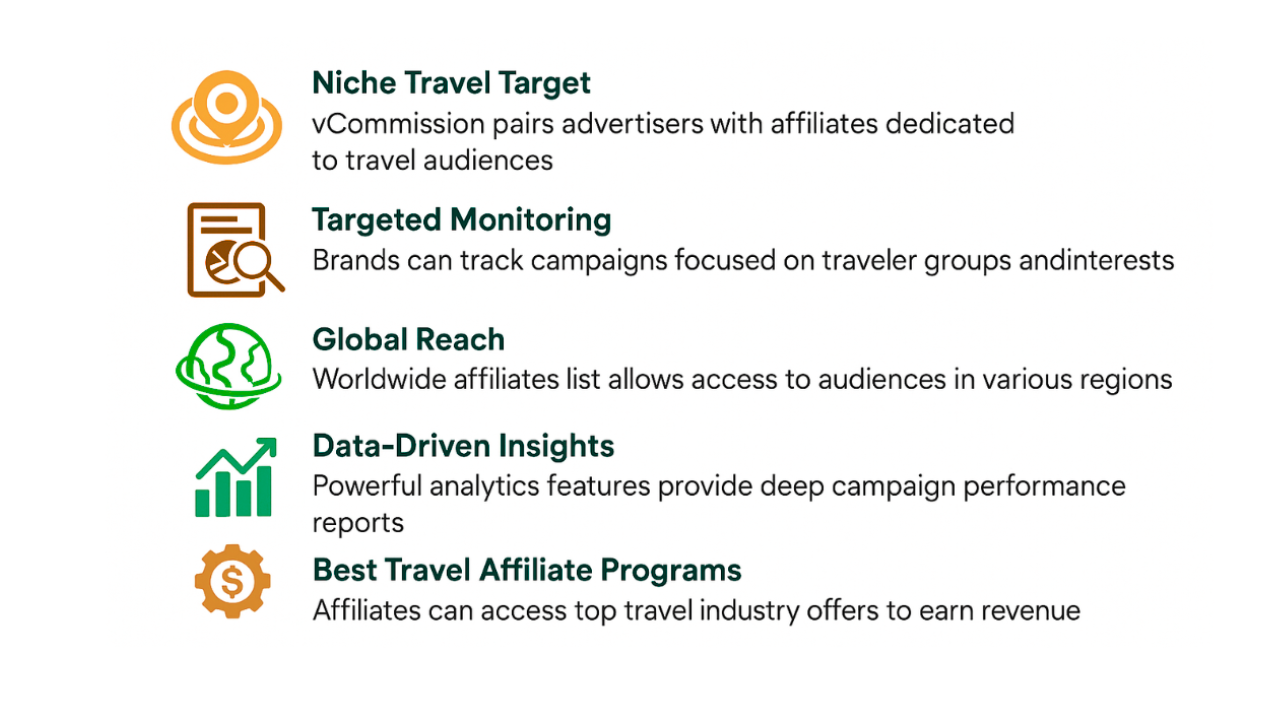
Niche Travel Target: vCommission brings together advertisers with affiliates that specializes solely in travel products and services. This guarantees your campaigns are directed to the most suitable target audience—serious travelers looking for hotels, destinations, tours, and bargains. Travel affiliates working with vCommission possess extensive experience in promoting travel-related products and services and are, therefore, the best partners to collaborate with for promoting your brand effectively. Travel businesses are assisted by expert promotion methods suited to their market.
Targeted Monitoring: Brands can track campaigns through vCommission’s precise targeting capabilities specifically designed for traveler-related groups and interests. By limiting performance measurement to defined profiles of travelers, brands can construct a better definition of the interests and actions of their audience. The information helps brands refine their campaigns for increased engagement and conversions. Targeting business travelers with frequent trips or vacationers, vCommission optimizes campaign performance.
Global Reach: With the help of vCommission’s worldwide affiliates list, travel companies can now reach out to audiences who are hundreds or thousands of miles away from home markets. The vast network covers numerous regions, so advertisers have access to affiliates that specialize in different geography- and culture-based needs. Through the global presence, brands have the opportunity to increase partner size and penetrate new markets, greatly accelerating business growth.
Data-Driven Insights: vCommission offers travel brands powerful analytics features that offer deep campaign performance reporting. Advertisers can use these data points to spot trends, monitor conversions, and maximize campaigns for enhanced performance. Data-driven decision-making ensures campaigns are optimized for utmost efficiency and ROI to enable brands to meet marketing objectives more efficiently. All decisions are supported by actionable data, yielding better results.
Best Travel Affiliate Programs: vCommission affiliates have the chance to gain access to some of the best travel industry affiliate programs, where they are offered chances to sell offers of leading travel brands while earning revenues. It is a win-win situation—affiliates earn stable revenues, and advertisers get publicity and sales.
Stay Ahead with vCommission
As the travel industry evolves, so must your marketing strategies. The 2025 affiliate marketing trends—everything from AI personalization to sustainability and mobile-first marketing—emphasize innovation, flexibility, and partnerships. To remain ahead of the curve, these trends must be embraced, and the right platforms will turn these ideas into reality.
vCommission, equipped with advanced software, targeted research, and the best travel affiliate programs, assists your brand to grow affordably and effectively. Whether you aim to drive maximum bookings, increase brand awareness, or connect with the new traveler, vCommission provides you with whatever it takes to succeed in this new era.
This is the time to take your travel brand’s affiliate marketing to new heights. Partner with vCommission and be at the forefront of the travel marketing revolution of 2025.
A 27% wake-up call. That’s what hit Indian exporters when the U.S. announced its latest reciprocal tariff in 2025. Almost overnight, cross-border commerce was thrown into chaos, and affiliates felt the aftershocks.
As global brands scale back and international offers lose profitability, Indian affiliates are facing a hard truth: the traditional model of relying on imported products and global campaigns is no longer built to withstand today’s economic volatility.
vCommission’s India COD Ecom provides a robust solution, offering affiliates a tariff-proof advantage. With a performance-first, locally-focused model, vCommission ensures affiliates can continue generating revenue while minimising the impact of rising costs and unpredictable global supply chains.
Let’s break down how the new tariff regime is reshaping affiliate marketing in India, and how vCommission’s India COD Ecom Model is helping them stay ahead.
The Impact of Tariffs on E-Commerce Affiliate Marketing
In 2025, India’s affiliate and trade ecosystem was shaken by two major policy changes: a 27% reciprocal tariff imposed by the United States on Indian exports, and India’s removal of exemptions on low-value imports from China. These shifts have sharply increased the cost of cross-border commerce, especially in categories like electronics, apparel, and fast-moving consumer goods.
For affiliate marketers, this means the old model, built on fast, cheap imports and high-margin international offers, is no longer sustainable. As brands like Shein and Temu scale back affiliate incentives, marketers are facing rising costs, tighter margins, and logistical hurdles that make international campaigns harder to execute.
Here’s what affiliates are now up against:
1. Increased Product Costs: Tariffs inflate the base price of imported goods, reducing profit margins for brands and commissions for affiliates. Higher prices mean fewer conversions and weaker ROI on international offers.
2. Fewer Global Offers: As international companies downsize or withdraw from India, affiliates have fewer high-converting global offers to promote. The result is a pivot to domestic offers that are stable but no longer highly competitive.
3. Crowded Domestic Campaigns: With more affiliates chasing the same local offers, competition is intensifying. Affiliates must now differentiate with stronger creatives, sharper targeting, and deeper engagement strategies.
4. Higher Risk of Failures: Shipping delays, customs blocks, and tariff disputes lead to cancelled orders and delivery issues. This erodes consumer trust and slashes potential payouts for affiliates.
5. Shrinking Affiliate Budgets: Global brands, under pressure from rising operational costs, are trimming their marketing spends, including affiliate payouts. That means lower commissions and fewer campaign slots for affiliates relying on international traffic.
The Role of India COD Ecom
According to Statista, over 60% of all e-commerce transactions in India are COD-based, with the number reaching 80% in tier-2 and tier-3 cities, where trust in online payments remains a significant barrier. For affiliates, COD offers a significant opportunity in a challenging E-commerce market in India.
Here’s why Ecommerce COD growth in India is more relevant than ever:
1. No Prepayment Friction: COD eliminates the prepayment friction that many Indian consumers experience when shopping online. When consumers don’t need to pay upfront, they are more likely to make a purchase, resulting in fewer drop-offs and higher conversion rates. With COD, affiliates can convert hesitant shoppers into loyal buyers, which ultimately drives more revenue.
2. Increased Order Volume: COD campaigns tend to generate higher order volumes than prepaid campaigns, especially when marketed through influencers or social media platforms. Mobile-first audiences, particularly in non-metro cities, tend to prefer COD due to the reduced financial risk. This enables affiliates to reach a larger audience with fewer barriers to entry.
3. Shielded from International Tariff Volatility: Affiliates using the COD model are shielded from international tariff hikes, customs hold-ups, and increased shipping costs because products are sourced and delivered locally. This is the right strategy in today’s volatile E-commerce market in India since it gives affiliates a stable environment in which to run ads without worrying about rising global prices.
Affiliate COD Ecommerce in India gives the power to run fast-moving, scalable campaigns with consistent payouts and minimal risk, making it a highly viable option in 2025’s tariff-driven landscape.
vCommission Breakthrough Solution for Affiliates
As India’s leading affiliate network, vCommission has developed a performance-first ecosystem that leverages India COD Ecom to offer affiliates a tariff-proof model. Here’s how vCommission is leading the way and transforming the affiliate marketing experience for Indian affiliates:
1. Focus on Local Brands and Domestic Fulfilment
vCommission has strategically aligned its offerings with the rapidly growing e-commerce sector in India. vCommission guarantees affiliates steady margins and regular payouts by collaborating with domestic brands and goods that are unaffected by foreign tariffs. Because of this dedication to local fulfilment, affiliates can concentrate on promoting high-conversion, high-margin products by mitigating the effects of international price increases, shipping delays, and customs duties.
2. Advanced Performance Optimisation
vCommission provides affiliates with a suite of powerful performance tools, including real-time tracking, advanced reporting, and smart optimisation to ensure campaigns are running at peak efficiency. Affiliates can make data-driven decisions to optimise their campaigns for higher conversion rates and better ROI.
This is how:
Direct Linking & URL Tracking: Transparent URL tracking and direct linking are advantageous to affiliates because they provide precise tracking of revenues and conversions. Affiliates can adjust their efforts based on the useful information they obtain about the performance of their traffic.
Sub ID Tracking: Affiliates can have a deeper understanding of campaign effectiveness by using Sub ID tracking, which enables them to segment campaigns by source, creative, or traffic segment. Affiliates can use this capability to optimise their campaigns for greater outcomes.
3. COD Infrastructure Built for Success
Because vCommission’s COD Ecom in India infrastructure is designed to be as efficient as possible, affiliates can use India’s most reliable payment option. Particularly in regions with low levels of trust in online payments, vCommission guarantees seamless transactions and increased conversion rates by collaborating with regional fulfilment providers.
vCommission’s order staging system informs affiliates about the status of their orders by following these three steps:
Step 1: Order placed
Step 2: Order confirmed & shipped
Step 3: Order received
4. Fast, Reliable Payments
Processing payments on time is one of the main issues that affiliates worry about. This is resolved by vCommission, which guarantees affiliates receive payment within seven days of delivery acknowledgement. Affiliates may scale their campaigns, reinvest their revenues quickly, and keep a consistent cash flow to expand their businesses thanks to our swift payout system.
5. Scalability and Agility for Long-Term Achievement
vCommission’s platform is made to be flexible and adaptable, enabling affiliates to easily adjust to shifting market conditions in an affiliate market as dynamic as India. The adaptable tools offered by vCommission ensure that affiliates grow their businesses without being constrained by external disturbances, whether they are testing new traffic sources, improving ad creatives, or leveraging new trends.
Final Thoughts
The tariff changes in 2025 have made it harder for affiliate marketers in India, especially those relying on international offers. However, the vCommission’s India COD Ecom model offers a strong, tariff-proof solution to help affiliates stay competitive in this challenging market.
By focusing on local fulfilment, offering smooth COD payment options, and providing performance tools, vCommission helps affiliates run stable, high-conversion campaigns with less risk. As global offers decline, local opportunities become more important, and vCommission ensures affiliates can stay profitable and grow, even with these challenges.
The future of Affiliate COD Ecommerce in India is changing, and vCommission is leading the way with a sustainable, performance-focused approach.
Google’s latest Chrome policy update might just put it to the test. To create a more secure and transparent browsing experience, Google has updated its Chrome Web Store policies related to the use of affiliate links, codes, and cookies in browser extensions. These changes, effective June 10, 2025, come at a critical time when concerns around deceptive affiliate marketing practices are on the rise.
As an affiliate, you may be wondering: What exactly does this policy mean for me? In this blog, we break down the key aspects of the update, its implications on the affiliate ecosystem, and how vCommission is helping partners stay ahead through transparency and an effective omnichannel strategy.
The updates in Google’s Chrome Web Store policy directly impact the use of affiliate links, codes, and cookies by browser extensions. The dishonest monetisation strategies are removed, and it is ensured that each affiliate link offers genuine value to users.
Let’s take a closer look, how:
1. Clear Disclosure of Affiliate Programs: Developers must now clearly disclose the presence of affiliate links in the Chrome Web Store listing, the extension’s user interface, and before installation. This means that users must be informed ahead of time, before they even begin using the extension, that it participates in affiliate programs. Hidden or buried disclosures will not meet the affiliate marketing compliance checklist standards.
2. Direct User Benefit is Mandatory: Affiliate links are only allowed if they provide an immediate benefit to the user. For example, if an extension applies valid coupon codes that lead to actual discounts or offers cashback for purchases, then affiliate linking is permitted. Extensions that covertly insert affiliate links without significantly improving the user’s browsing or purchasing experience are discouraged by this modification.
3. No Passive or Unrelated Affiliate Link Injections: Extensions are now prohibited from injecting affiliate links into websites without direct user action. This means that unless a user takes a specific, intentional step, such as clicking a button to apply a coupon, the extension cannot apply affiliate cookies or links in the background. This also puts an end to practices where extensions replace a publisher’s original affiliate link with their own, a tactic that has previously led to revenue losses for legitimate content creators.
4. Alignment with User Intent: Google makes it clear that any affiliate activity needs to be the consequence of direct user interaction. The extension cannot run in the background to collect affiliate commissions if a user is not using it. Giving users total control over their browsing experience and making sure they are aware of when and how monetisation takes place are goals that the affiliate marketing rules support.
The Significance of This Update for Affiliates
Google’s policy update has a number of advantages, even though it interferes with more traditional techniques like stealth link injections and passive affiliate cookie drops:
1. Protecting User Privacy: Extensions are now required to declare the use and timing of affiliate links. This keeps users informed about what’s happening in their browser and prevents unlawful data use.
2. Restoring Affiliate Marketing Credibility: The Honey issue (controversy where the browser extension Honey was found to replace original affiliate links with its own), among others, has harmed trust in affiliate marketing. Google’s new affiliate marketing rules aim to rebuild that trust by eliminating dishonest business practices and encouraging open disclosures.
3. Rewarding Ethical Marketers: Those who have continuously focused on offering real value (for example, by offering valid coupons or cashback) will be rewarded. Ethical marketing is the rule now, not the exception.
4. Promoting Smarter Strategies: Affiliates who previously relied on extensions are now required to reconsider their strategy. Each affiliate activity needs to have a clear reward and be a user-initiated step. Cleaner UX and more deliberate involvement are encouraged by this change.
The Shift Toward Omnichannel Affiliate Strategies
This is the ideal moment for affiliate marketers to implement an omnichannel approach, as Google’s revised Chrome policy has put browser extensions under more scrutiny. In addition to safeguarding your income, diversifying your traffic sources guarantees that your marketing remains user-focused, transparent, and compliant.
Here is a breakdown of successful affiliate networks and how to use them:
1. Content Marketing and Blogging: One of the most reliable affiliate marketing strategies is still posting thorough product evaluations, comparisons, and how-to guides on your blog. When done correctly, this increases credibility and provides long-term SEO advantages. Make sure to optimize for search intent and long-tail keywords and to disclose affiliate relationships in a clear and concise manner.
2. Email and SMS Campaigns: Direct communication channels like email newsletters and SMS allow you to deliver personalised offers to a highly engaged audience. To remain compliant, obtain clear consent from subscribers, and also make it easy for users to opt out.
3. Social Media Marketing: Platforms like Instagram, Facebook, Twitter (X), LinkedIn, and TikTok are excellent for building communities and promoting affiliate products. You can use product demos, reels, and short tutorials, story links and swipe-up features, and live sessions with product Q&As.
4. YouTube and Video Content: From unboxing videos to in-depth tutorials and reviews, YouTube makes it possible to produce rich, engaging content. Best practices include just recommending things you genuinely believe in and including affiliate disclaimers in descriptions.
5. In-App Advertising: Many affiliates overlook mobile apps as a channel. You can partner with apps that align with your niche or create your own affiliate-powered utility apps. Make sure the affiliate elements serve a clear benefit (like deals or discounts) and the users are informed and opt in for data collection.
6. Native and Programmatic Advertising: Native advertisements are less obtrusive and more in line with Google’s user-centric monetization strategy since they mix in perfectly with the content of the website. These can be positioned via programmatic ad networks that target certain user segments, sponsored articles on websites run by big publishers, and content suggestion widgets.
7. Coupon and Cashback Websites: Sites like CashKaro, GrabOn, and RetailMeNot still drive significant conversions, especially in price-sensitive markets. Just ensure that the coupons are valid and beneficial, disclosures are clear, and the platform doesn’t manipulate existing affiliate links.
8. Influencer Collaborations & Affiliate Partnerships: Partnering with niche influencers or other affiliate marketers to cross-promote offers can expand reach organically. Use trackable links and be transparent about sponsorships.
How vCommission Future-Proofs Affiliate Campaigns
At vCommission, we’ve always believed that ethical practices and smart technology go hand-in-hand. Here is how we empower our partners to navigate these changes in the following ways:
1. The Transparency-First Strategy: We have consistently promoted ethical and open affiliate marketing. Our platform ensures that all campaigns are structured with full disclosure, and we work closely with partners to make sure their implementations follow best practices, whether on websites, apps, or browser extensions.
2. Omnichannel Affiliate Strategy: Rather than relying heavily on any single channel (like browser extensions), vCommission encourages a well-rounded affiliate strategy. By assisting partners in diversifying their web, mobile, social, and in-app placements, we lower risk and dependency while increasing reach.
3. Assistance with Compliance and Instantaneous Updates: Our affiliate network is informed of industry developments by our team, which keeps a close eye on them. We provide guidance, resources, and technical support to help affiliates implement necessary changes and avoid penalties, especially during major affiliate policy compliance shifts like this one from Google.
4. Resources for More Astute Campaigns:Affiliate rules monitoring can be done by performance channel, optimising offers that deliver real user value (such as cashback or promotions), and testing ads that comply with Chrome’s policy using our dashboards and tracking systems. Partners can shift from passive tactics to more deliberate, compliant marketing with the aid of this data-driven approach.
5. Preserving Attribution and Commissions: The loss of affiliate commissions as a result of unapproved link replacements is one of the main issues brought up by the policy. At vCommission, we’re dedicated to upholding attribution integrity and making sure that commissions are paid to legitimate publishers rather than dishonest tools.
Final Words
An important milestone for affiliate marketing has been reached with Google’s Chrome policy modification, which now promotes transparency, user intent, and genuine value. Stealth tactics and shortcuts are not appropriate at this time. Now is the moment to intensify omnichannel compliance initiatives that meet changing consumer demands and legal requirements.
With vCommission’s transparency-first approach, real-time affiliate marketing compliance checklist, and robust omnichannel tools, we ensure our partners stay ahead. As browser-based affiliate practices evolve, vCommission empowers affiliates to expand reach, protect attribution, and build long-term, high-converting strategies that stand the affiliate policy compliance and platform changes. The future of affiliate marketing is ethical, data-driven, and omnichannel, and vCommission is where it begins.
People don’t shop the way they used to. They scroll through social media, search for reviews, read blogs, and click on ads before finally buying something. This means using just one marketing channel doesn’t work anymore.
A Harvard Business Review study reveals that 73% of consumers use multiple channels during their shopping journey, highlighting the importance of reaching audiences across touchpoints with consistency and strategy.
This is where omnichannel affiliate marketing becomes essential. It enables advertisers to collaborate with affiliates who can engage users across platforms, formats, and devices. The goal is to deliver seamless brand experiences while keeping performance measurable and results-driven.
This guide outlines how affiliates can use omnichannel strategies to maximize reach, boost conversion rates, and unlock sustainable growth.
What is Omnichannel Affiliate Marketing?
Omnichannel affiliate marketing is the practice of promoting offers across multiple digital platforms, content sites, search engines, social media, email, mobile apps, and beyond while maintaining consistency in brand experience and intent alignment.
For affiliates, this means understanding how consumers interact with content, ads, and offers at each stage of the buying journey and building systems that meet users where they are.
When executed properly, omnichannel affiliate marketing allows you to reach broader and more diverse audiences. There is an increase in conversion rates through personalised, context-aware messaging. It will eventually reduce dependency on any single channel or algorithm. Affiliates can further optimise budget and time with high-impact media mixes.
The Rise of Omnichannel Affiliate Marketing in 2025
As consumer behavior continues to evolve rapidly in 2025, advertisers face new challenges in connecting with their target audiences. People switch between devices and platforms constantly. They may discover a brand on social media, read about it on a blog, and finally convert after seeing an ad or offer on a cashback site.
A presence across multiple channels ensures that every stage of the journey is covered. Affiliates who show up consistently across those platforms win more conversions. Relying too heavily on a single platform, such as a paid search or social media, can be risky due to rising costs or changing algorithms. Omnichannel affiliate marketing helps reduce this risk by diversifying your reach and spreading performance across different traffic sources.
Brands want results, not just impressions. Affiliates who deliver CPL, CPS, or CPI outcomes across platforms stand out and earn more. According to Forbes, brands with strong omnichannel customer engagement strategies retain an average of 89% of their customers, compared to just 33% for companies with weak engagement strategies. That alone signals why adopting an omnichannel approach is no longer optional; it’s essential.
How Top Affiliates Build an Omnichannel Strategy
To drive consistent conversions and long-term profitability, affiliates need more than presence across channels; they need a connected, data-driven strategy. Here’s how high-performing affiliates are building omnichannel systems that work:
1. Map the Customer Journey
Affiliates who succeed at scale understand how their audience moves from awareness to action. Start by identifying the micro-moments across the customer journey, including:
Where do users first learn about products? (e.g., social reels, YouTube shorts, native ads)
Where do they seek reviews, comparisons, or deeper info? (e.g., blogs, influencer content, email)
What’s the last click before purchase? (e.g., cashback, coupons, retargeting ads)
Use this map to design your process and allocate traffic budgets accordingly. Rather than running one campaign everywhere, build sequences: discovery on reels, followed by email retargeting, and closed with a coupon offer. Each platform plays a defined role.
2. Use Diverse Traffic Sources
Top affiliates don’t rely on a single channel; they engineer synergy between platforms. Here’s how to structure a multi-source approach:
SEO and blog content to capture intent and build trust
Social media ads and reels for discovery and engagement
Email campaigns for nurturing and retargeting
Native ads for contextual storytelling
Cashback and deal sites for last-click conversions
3. Maintain Brand and Offer Consistency
An omnichannel presence without consistency will confuse users and dilute conversions. Ensure your messaging, visuals, and offer positioning remain aligned across platforms. Use consistent brand tone and messaging across ads, landing pages, and emails.
Adapt creative formats (video, image, text) to fit the channel but maintain thematic coherence. Centralise your offer links, disclaimers, and pricing to avoid misinformation and ensure compliance.
4. Use Real-Time Tracking and Attribution
You can’t scale what you can’t measure. Omnichannel affiliates rely on accurate tracking, attribution and fast data feedback to identify winners and cut losses. With vCommission’s real-time dashboards, affiliates can:
Track conversions by channel, creative, and campaign
Monitor click-to-conversion ratios
Identify high-earning placements and optimize media spend
Access detailed logs to audit performance and adjust targeting
How vCommission Powers Omnichannel Affiliate Execution
Affiliates need infrastructure that can support scale, compliance, tracking, and performance optimisation to operate effectively across multiple touchpoints. vCommission provides a robust ecosystem enabling affiliates to build and execute omnichannel strategies confidently and quickly.
1. Mobile Marketing
Affiliates can access CPI (cost per install) and CPL (cost per lead) offers specifically designed for mobile-first audiences. Monetize app installs through push notifications, in-app banners, mobile web placements, and device-level targeting. vCommission’s mobile stack supports granular optimisation, including OS segmentation, geo-targeting, and device-level tracking to maximise ROI.
2. Content & Influencer Marketing
Affiliates operating long-form blogs, niche content sites, or social channels can access high-quality, brand-safe campaigns on vCommission that integrate seamlessly into native content. Promote top-tier brands via product reviews and listicles, video explainers and tutorials, and influencer shoutouts on Instagram, YouTube, or Threads (if you own or manage the channel).
These content-driven placements perform especially well in verticals like beauty, finance, education, and wellness, where authenticity and storytelling drive conversions.
3. Email Marketing
Affiliates with access to opt-in, permission-based email databases can run high-conversion CPL and CPS campaigns through vCommission’s platform. Use segmentation and behavioral triggers to create campaign variants, such as welcome offers for new users, abandoned cart reminders, and reactivation emails for lapsed audiences.
Email remains a powerful channel for verticals like financial services, high-ticket eCommerce, and direct-to-consumer brands where timing, relevance, and user intent drive measurable results.
4. Social Media Campaigns
vCommission’s offer campaigns optimised for promotion across Meta (Facebook, Instagram), TikTok, and Snapchat, both organically and via paid media. Affiliates can deploy reels, Stories, or video ads featuring tracked CTAs. They can also use carousel or collection formats for product-focused creatives. Where platform policies permit, affiliates can run lead-generation campaigns using integrated forms, supported by vCommission’s real-time tracking infrastructure for seamless attribution.
This approach performs well in visually-driven verticals like fashion, health, travel, and direct-to-consumer brands where discovery and impulse engagement drive conversions.
5. Cashback and Coupon Partnerships
vCommission maintains exclusive relationships with top-performing cashback platforms, coupon sites, and browser extension publishers. Affiliates can drive high-intent traffic at the final stage of the purchase journey, maximising last-click conversion potential.
Ideal for verticals such as eCommerce, consumer electronics, education, and travel, especially during seasonal or limited-time promotional windows.
6. Native & Programmatic Advertising
Affiliates can leverage native ad placements and programmatic advertising to scale campaigns through third-party networks like Taboola and Outbrain or other programmatic platforms. vCommission supports affiliates by providing:
Vetted tracking links to ensure all clicks and conversions were accurately recorded.
Creative guidelines for compliance with various advertising platforms, ensuring campaigns align with brand standards.
Performance reporting for higher CTR (Click-Through Rates) and better CPC (Cost Per Click) performance across their native ad placements.
Conclusion
In today’s world, customers don’t follow a straightforward path to purchase. They interact with brands through social media, emails, blogs, ads, and more. That is why omnichannel affiliate marketing is so important: It helps affiliates reach customers across all these platforms, creating a smooth and consistent experience.
With vCommission, affiliates can easily track their performance across different channels, ensuring they know exactly what works. Affiliate can optimise their efforts using vCommission’s tools for mobile marketing, content integration, email campaigns, and cashback partnerships. By using multiple channels and staying consistent with messaging, affiliates can engage more customers, improve conversions, and grow their profits. Join vCommission and keep yourself ahead in affiliate marketing!
Everyone wants performance without the risk, affiliate marketing delivers exactly that. It’s no surprise that 81% of brands globally use it to grow faster and sell smarter (Statista). But here’s the truth: launching a program isn’t enough. Without strategy, brands get lost in the crowd while others take the lead.
So what’s the difference between a mediocre affiliate strategy and one that scales profitably?
This is where a few lesser-known yet highly effective affiliate marketing principles come into play. If you are a brand looking to expand reach, these five affiliate marketing secrets can significantly improve the way you attract, engage, and convert customers through partners.
Let’s dive into what the most successful brands are doing differently and how you can adopt the same approach.
1. Think Beyond Discounts & Craft an Offer That Sells Value
A common trap for many brands is assuming that affiliates only need attractive discounts or commissions to drive conversions. While competitive payouts matter, what separates high-converting offers is value alignment.
Communicate urgency or exclusivity (e.g., limited bundles or region-specific perks).
Reflect the affiliate’s audience needs, not just your product features.
Top-performing brands tailor their landing pages, creative assets, and messaging specifically for each affiliate niche, whether it’s finance bloggers, beauty influencers, or cashback platforms. They treat affiliates as performance partners, not just resellers.
Tip: Collaborate with affiliates on message positioning and content strategy. Data shows that custom campaigns often outperform generic ones by 2–3x.
2. Choose Partners Strategically, Not Just by Reach
It’s tempting to chase affiliates with massive followings or flashy metrics. But smart brands dig deeper.
The real question is: Does this affiliate influence buyer intent in my category?
Here’s what successful brands look for:
Contextual fit – Does the content match your brand values and customer journey stage?
Audience trust – Are followers genuinely engaging or passively scrolling?
Vertical expertise – Is the affiliate known for driving results in your niche?
For example, when entering the Indian market, high-performing brands don’t just partner with top influencers; they seek out content creators, coupon sites, and media buyers who understand local buying behaviour, language, and digital habits.
3. Use Real-Time Data to Optimise in Motion
Affiliate marketing isn’t a “set it and forget it” model. The most profitable programs are dynamic; they rely heavily on real-time insights to guide decisions.
Here’s how they do it:
Track deep-funnel metrics – Instead of focusing only on clicks or conversions, monitor quality signals like average order value, repeat rates, and user retention.
A/B test creative variations – Top brands experiment continuously with banners, CTAs, and landing page formats.
React to seasonality and trends – Aligning campaigns with local festivals, shopping events, or viral content can spike performance.
4. Don’t Limit the Channel; Go Omnichannel
Affiliate marketing is no longer just about coupon sites and blogs. Today’s high-performing programs span:
Social media shoutouts from micro-influencers
App-based traffic and push notifications
Email newsletters from niche publishers
Native placements on content recommendation engines
Retargeting campaigns through media buying affiliates
Top brands understand this and use an omnichannel affiliate mix to maximise reach at every stage of the funnel, from awareness to purchase. This not only diversifies traffic sources but also improves attribution clarity.
5. Set Clear Rules but Empower Flexibility
Successful affiliate programs are built on trust and transparency. That starts with well-defined rules, but also a flexible framework for growth.
Incentivise innovation – Allow affiliates to pitch new campaign angles, offer structures, or A/B tests.
Recognise top performers with tiered rewards, early access to product drops, or private tracking links.
Top brands treat affiliates not as vendors but as strategic partners. They create room for experimentation while maintaining guardrails to protect brand equity.
How vCommission Powers Scalable Affiliate Programs
Affiliate marketing success is rarely about launching fast; it’s about launching right. What often holds brands back isn’t a lack of budget or intent but the operational disconnect between strategy, execution, and publisher alignment.
vCommission bridges that gap.
As India’s most experienced performance marketing network, vCommission offers a complete growth stack from brand-aligned campaign architecture to real-time optimisation built for scale. Whether you’re entering new geographies, expanding product lines, or switching from traditional media, vCommission gives your affiliate program the structure, reach, and intelligence to perform predictably at scale.
Here’s how it works:
1. Structured Onboarding With Strategic Focus
vCommission’s onboarding framework doesn’t just collect your campaign brief; it translates your business model into a high-impact affiliate strategy.
This includes:
Brand Positioning Audit: We assess your target segments, USPs, and funnel performance to determine your optimal payout structure and campaign positioning.
Traffic Suitability Assessment: Whether your primary focus is app installs, lead gen, or sales, we identify which affiliate traffic models best align with your KPIs: CPS, CPA, CPI, CPR, or CPV.
Market Intelligence Mapping: Your competitors, vertical trends, and local nuances (especially in markets like India) are benchmarked to craft a differentiated offer strategy.
Dedicated Campaign Ownership: You’re assigned an industry-specific account manager who owns campaign execution and publisher coordination from day one.
The goal: Launch with clarity, not chaos.
2. Full-Funnel Tracking and Seamless Integration
vCommission operates on a robust tracking engine built for affiliate performance marketing. This allows brands to track everything from the first click to the final sale with transparent attribution and actionable insights.
Real-time reporting dashboards with fraud controls
Customisable tracking macros and third-party integrations
For advertisers using their own tracking platforms, vCommission ensures complete technical alignment, including macro setup, event mapping, and pixel placement for accurate measurement across every campaign touchpoint.
3. Curated Publisher Access at Scale
vCommission isn’t just a network; it’s an ecosystem. With over 100,000 active affiliates, the platform connects your campaign to affiliates that match your product category, geo targets, and acquisition goals.
Available publisher categories include:
Cashback and coupon sites
Influencer networks and content creators
Email and push marketing affiliates
OEM traffic and mobile discovery platforms
Programmatic and native ad placements
Each campaign is curated, not dumped into a public marketplace. Affiliates are selected based on performance history, content fit, and compliance alignment. That means better CTRs, higher-quality conversions, and a cleaner funnel.
4. End-to-End Campaign Setup and Compliance Management
Once campaign terms are approved, vCommission handles every operational detail behind the scenes:
Creative Distribution: Your banners, product feeds, emailers, and landing pages are reviewed, formatted for affiliate use, and pushed to publishers.
Compliance & Legal Checks: Campaigns are pre-screened for ad policy compliance (especially for verticals like BFSI or health) and geo-based regulatory adherence.
Asset Readiness: If you’re running lead gen or app campaigns, vCommission helps you configure UTM-tagged landing pages, secure app tracking, and deploy creatives tailored to each traffic channel.
This ensures your campaign is not only live, but fully compliant and optimized for multi-channel activation from day one.
5. Growth Management With Real-Time Optimisations
Once your campaign is live, the real work begins: performance management.
vCommission’s account teams function like embedded growth partners. Their role isn’t just to monitor; it’s to drive scale while protecting ROI.
They do this through:
Continuous publisher performance audits
Daily funnel health tracking and data reviews
Creative A/B testing and refresh cycles
Scaling roadmaps by traffic type or geography
Custom incentives and exclusive offers for top affiliates
vCommission campaigns don’t plateau; they evolve. By identifying early indicators of scale (or inefficiency), your program is refined week after week, unlocking consistent acquisition with lower CPA and improved retention.
Final Thoughts
Affiliate marketing isn’t a quick fix; it’s a long-term performance channel that, when executed right, becomes one of the most scalable and cost-efficient levers in your marketing mix. The most successful brands aren’t just running affiliate programs; they’re running them with intent, infrastructure, and strategic depth.
With over a decade of affiliate intelligence, deep publisher curation, and industry-specific campaign execution, vCommission helps brands go beyond one-off campaigns and build durable, scalable performance ecosystems. From onboarding to optimisation, every part of the process is engineered to align with your business outcomes, whether you’re launching in India or scaling globally.
If you’re ready to move past average results and build an affiliate program that drives real business growth, vCommission is the partner built to make that happen.
The global travel industry is expected to hit $300 billion in 2025. That’s not just a big number; it’s a massive opportunity for affiliate marketers. As more people pack their bags and explore the world, they’re also booking flights, hotels, and activities online, opening up exciting ways to earn commissions by guiding them to the right choices.
Affiliate marketing should be your next significant move if you love travel and enjoy sharing your experiences. Whether you’re a blogger, a content creator, or someone curious about making money online, now is your time to explore the travel affiliate space.
In this blog, we’ll walk you through how to succeed as a travel affiliate in 2025 from choosing a niche and mastering content and promotional strategies.
Understanding Travel Affiliate Marketing
Travel affiliate marketing means promoting travel-related services and products online. When someone books or buys using your unique affiliate link, you earn a commission. It’s that simple. Affiliates use different platforms to share their content: blogs, social media, YouTube channels, email newsletters, and more. You can promote hotels, flights, travel insurance, gear, or experiences.
The best part? Travel content usually matches what people are already searching for. Someone reading about a destination may also be ready to book a hotel or buy travel gear. That’s why affiliate marketing works so well in this space. When you partner with a trusted affiliate network like vCommission, you get access to well-known travel brands and high-converting offers. You also get reporting tools and account support that help you track performance and improve your results.
2025: Key Year for Travel Affiliate Marketing
In 2025, the travel industry is expected to grow like never before. This is driven by the affiliate travel marketing trends:
Travelers are increasingly seeking eco-friendly options, from sustainable hotels to green activities.
The digital nomad lifestyle is growing, with remote workers traveling long-term and needing services like flexible accommodations and gear.
Influencer marketing is evolving. Affiliates with a strong social presence can combine influence and affiliate promotions to maximize impact.
Personalized travel experiences are in demand, and affiliates can deliver custom content that connects with specific types of travelers.
AI is becoming a useful tool for affiliates, helping with content generation, customer targeting, and analytics.
Mobile-first behavior is the norm; people plan, research, and book their trips through their smartphones.
High-ticket travel products like luxury tours, cruises, and private stays are gaining popularity, offering higher commission potential.
Social proof and credibility through reviews, testimonials, and UGC (user-generated content) are more important than ever.
Collaborations with micro- and nano-influencers help reach niche audiences more effectively.
All these trends make 2025 a powerful year to be in travel affiliate marketing and vCommission is ready to support affiliates every step of the way.
Choosing the Right Travel Niche
Picking a niche is one of the most important steps in your affiliate journey. A niche helps you focus your content and connect with the right audience. Start with your interests and experience. If you love hiking or luxury hotels, focus on that. When you speak from real experience, people trust your recommendations.
Next, check if people are searching for your niche online. Use resources like keyword planners and Google Trends. A large number of people searching for topics related to your niche is a positive indication. Examine earning potential now. Can you market affiliate items or services in your niche? Can you sign up for programs that offer lodging, travel insurance, or equipment in that region? Select a long-lasting specialty as well. Avoid obsessing over trends that may fade. Pick something that stays relevant all year.
Some of the trending travel niches are budget travel (for students and backpackers), luxury travel (for high-end tourists), eco-friendly travel (for sustainable tourists), and digital nomad travel (for remote workers). vCommission works with many travel brands that cater to these niches. This makes it easier for you to find the right offers.
Content Strategy That Works
Informative and engaging content is what drives traffic and earns commissions. Here is how you create it:
Start by understanding your readers. Are they solo travelers, families, or luxury seekers? Once you know their needs, you can create content that truly helps them.
Share useful and authentic information. Write destination guides, packing tips, or travel hacks. If you’ve visited a place, share your experience honestly. Include affiliate links to hotels, gear, or services you used.
Photos and videos make your content pop. They also help people trust your reviews. Use high-quality visuals to support your writing.
Avoid being too sales-y. Mention affiliate products as part of your story. For example, if you write about your trip to Goa, include links to the hotel you stayed at or the travel insurance you used.
Explore different content types like blog posts, videos, social media posts, and email marketing.
Promoting Your Content
vCommission offers access to travel affiliate programs that perform well across these types of content, helping creators reach and convert audiences effectively. Once your content is ready, you need to share it widely:
Think about where your audience spends time. Instagram, Pinterest, YouTube, and travel blogs are all good places. Focus on 1-2 channels to start. Create a content calendar and stick to it. Post regularly to keep your audience engaged and helps build trust.
Optimize your blog posts for keywords. Use simple titles and descriptions. Add internal links and meta tags. Partner with other travel bloggers or influencers. Cross-promotion can help you reach new audiences.
Post often and reply to the comments to improve engagement. You can also run travel polls or Q&As. The more you engage, the more people trust you. Start collecting emails early. Offer a free travel guide or checklist. Then send useful content, tips, and affiliate deals.
If you have the budget, try ads on Facebook or Google. These can help boost a new blog or promote specific offers. Analytical tools can be employed to determine what works. Track traffic sources, sales, and clicks. You can optimize your campaigns by using the real-time tracking and reports that vCommission offers.
To Sum Up
The year 2025 is ideal for committing to travel affiliate marketing. There are more affiliate opportunities than ever before due to the tourism industry’s expansion. You may develop a business that expands over time by picking a wise niche, producing quality material, and advertising it often. By partnering with vCommission, you can access leading travel brands, real-time data and tracking tools, and committed support.
Remember, you’re not just earning; you’re building a brand around your passion. So, start your travel affiliate journey with vCommission today and turn your love for travel into income!
In an industry where tech powers almost everything from campaign tracking to payouts, it’s tempting to believe all the magic happens online. But here’s something to think about: A Freeman’s survey found that 80% of people view in-person events as the most trustworthy source of information.
That’s a big number. And at vCommission, we’ve seen the benefits of face to face interaction firsthand.
Even in today’s digital-first, performance-driven world, we’re showing up in person, at global stages because that’s where the real conversations happen. And those conversations? They lead to smarter campaigns, stronger partnerships, and big picture thinking you just can’t replicate over Zoom.
Last year, we made our rounds across the globe. From AW Dubai to Pi Live, Global Fintech Fest to Sigma Eurasia, we were in the rooms where strategies sparked and trends took shape. These weren’t just pit stops, they were power moves.
Why In-Person Matters in Affiliate Marketing
In a world where messages are automated and meetings are virtual, the real magic still happens face-to-face. For vCommission, face to face interaction benefits aren’t just visibility, they’re about deep, meaningful engagement that drives long-term impact.
We don’t attend events to tick a box. We show up to understand market shifts as they happen, strengthen affiliate relationships, and bring back strategies that actually move the needle.
Here’s how being on the ground gives vCommission a competitive edge:
1. Stronger Relationships Start Offline
Affiliate marketing is ultimately about performance, but performance depends on trust. You can optimise campaigns all you want, but if there’s no mutual understanding between the affiliate and the network, it won’t go far.
That’s where face-to-face meetings change the game. At global events like AW Dubai and Affiliate Summit West, we meet our partners without screens or time zones in the way. There’s room for open dialogue about challenges, strategy, or even shared wins. That kind of energy is hard to replicate online.
Sometimes, a single conversation over coffee turns into a months-long collaboration. We’ve seen it happen. At AW Asia Bangkok, spontaneous conversations with affiliates and media buyers often turned into high-performing campaign ideas. It’s these moments of real connection that let us move from “Let’s test something” to “Let’s build something.”
2. Real-Time Market Intelligence
When you’re in the thick of it on the expo floor, in a panel discussion, or at an after-hours roundtable, you get a feel for what’s really happening in the market.
At events like Traffic Conversion Summit and Lead Generation World, we listen closely. What funnels are converting now? Which traffic sources are losing steam? What creative angles are overplayed? These aren’t things you’ll always find in a blog post or a newsletter.
We take those insights back and apply them directly to our affiliate strategies whether it’s updating prelanders, refining traffic guidelines, or helping advertisers reposition their offers. It’s intel with instant application.
And at events like #IAS24, we dig into the next layer how privacy policies, AI-driven optimization, or evolving attribution models are shaping performance marketing in real time. The conversations there help us think not just about how campaigns work today, but how they’ll need to work six months from now.
3. Vertical Expertise from the Source
Not all verticals operate the same. The playbook for running finance campaigns is very different from iGaming or ecommerce. That’s why we step into vertical-specific events to go deep, not just wide.
At Global Fintech Fest, for example, we met directly with fintech founders and global advertisers. We heard about shifting user expectations, how financial trust is built online, and why certain offers work better with vernacular content.
Similarly, at Sigma Eurasia and Sigma East Europe, we immersed ourselves in the world of iGaming. These markets move fast, and regulations vary by country. Meeting affiliates, traffic owners, and platforms on-site helped us refine how we scale responsibly and compliantly in this space.
Such benefits of face to face interaction help us make better recommendations to both sides of the table on what to run, how to run it, and what to watch out for.
4. Local Knowledge That Drives Performance
While vCommission is a global network, India and APAC remain at the heart of our growth. And nothing beats boots-on-the-ground insight for understanding what’s really driving conversions in these regions.
At events like Adtech New Delhi, Spice Series, and Amplify Summit, we don’t just attend, we actively listen. We talk to regional publishers who are unlocking new audiences in tier-2 cities. We meet advertisers who want to understand how to scale without losing quality.
It’s through these conversations that we get real input like how Hindi-language creatives are outperforming English ones in some markets, or how mobile-first strategies are evolving post-5G rollout.
That kind of feedback helps us optimize campaigns not only by numbers but by nuance. And in diverse markets like India, nuance is everything.
5. A Front-Row Seat to What’s Next
Affiliate marketing doesn’t stand still. New tools, new channels, new formats they’re always coming. And the best place to spot them early? Events that bring innovators together.
At Pi Live, Affiliate Summit East, and ClickBid World, we’re not just networking, we’re exploring. What’s happening with TikTok traffic? How are influencers moving into CPA models? Which tracking platforms are offering the most reliable cookieless attribution?
Even outside pure affiliate spaces, we’re looking ahead. At Seamless, we explored how fintech, ecommerce, and payments are converging and what that means for performance partnerships.
Being in those conversations helps us future-proof vCommission’s platform and ensure our affiliates and advertisers stay one step ahead of the curve.
To Sum Up
We all know how much tech powers everything today, from tracking to meetings, but here’s the thing: there’s still no substitute for being there in person. At vCommission, we’ve found that the best connections and ideas happen when we step away from our screens and actually show up.
Take events like AW Dubai or Pi Live, for example. It’s not just about attending, it’s about being part of the conversations that truly matter. There’s something about face to face interaction benefits that makes them so much more impactful than a Zoom call. You can actually feel the energy, hear new perspectives, and share ideas in ways that online just can’t match.
And those casual chats? They can turn into long-lasting partnerships or strategies that make a real difference. We’ve seen it happen again and again.
Sure, we rely on digital tools to keep things running smoothly, but in-person events? They’re where the real magic happens. That’s why, for us at vCommission, showing up in person is always worth it. It’s where the best ideas and opportunities come to life.
Affiliate marketing is no longer a side channel for e-commerce brands; it’s a core driver of performance. According to a report by Statista, affiliate marketing accounts for over 16% of all e-commerce sales in the U.S. alone, making it one of the top four sources of online sales. This kind of impact is only possible when the program is managed with precision, backed by the right infrastructure, and aligned with measurable business outcomes.
Yet, many brands still struggle to extract full value from affiliate marketing due to avoidable missteps. Whether it’s underestimating channel diversity, using outdated tracking systems, or partnering with the wrong affiliates, these errors can slow growth and undercut ROI.
Here are five of the most common affiliate marketing mistakes e-commerce brands make and how to avoid them by adopting best practices grounded in performance, accountability, and scale.
Mistake 1: Partnering with the Wrong Affiliates
One of the most common affiliate marketing mistakes e-commerce brands make is assuming that all affiliate traffic is valuable. But not every affiliate brings the right audience, conversion intent, or promotional quality to the table. Collaborating with affiliates who operate outside your niche, use generic or non-compliant promotional methods, or focus on volume over quality can result in poor traffic quality, inflated acquisition costs, and brand misalignment.
Brands that don’t actively evaluate the relevance, strategy, and historical performance of their affiliate partners often find themselves chasing metrics that don’t translate into sales or loyalty.
How to Avoid It:
Work only within affiliate ecosystems where partner selection is data-driven and aligned with your vertical. vCommission has a rigorous affiliate evaluation process that looks at:
Vertical expertise – ensuring affiliates have proven success in your niche.
Promotion methods – reviewing how they drive traffic (e.g., SEO, social, email).
Historical performance – analysing conversion rates, traffic consistency, and ROI.
Content relevance – verifying how authentically your brand fits within their content or platform.
By curating high-performance affiliate rosters, vCommission ensures your campaigns run with partners who have already demonstrated their ability to deliver results within your industry.
Mistake 2: Overlooking Compliance and Brand Safety
In affiliate marketing, your brand may appear in many places across cashback websites, email newsletters, influencer content, or social video ads. Without controls in place, this can quickly spiral into misrepresentation, unauthorised messaging, or even ad policy violations on major platforms.
Unregulated affiliate activity can not only impact trust in your brand but also lead to penalties from ad platforms, customer confusion, or even legal repercussions, depending on your vertical (especially in finance, health, and education).
How to Avoid It:
Maintain strict governance over where and how your brand appears. vCommission enforces a compliance-first environment with pre-approved creatives and messaging guidelines to maintain consistency and controlled access to campaigns so only verified, brand-suitable affiliates participate. Tracking and reporting systems that surface any anomalies or violations early.
This ensures full transparency into affiliate activity and protects brand reputation at every stage of the campaign lifecycle.
Mistake 3: Ignoring the Full Customer Journey
Assuming that a single contact, such as a visit from a deal site, should result in an instant conversion, many e-commerce advertisers only pay attention to last-click attribution. In practice, it frequently takes several touchpoints for clients to go from awareness to decision.
Brands lose out on increased engagement and enduring loyalty when affiliate tactics disregard this path and do not guide users through the stages of discovery, education, and consideration.
How to Avoid It:
A well-designed affiliate program supports users throughout their buying process to save brands from such affiliate marketing mistakes. vCommission’s omnichannel execution enables brands to engage audiences across content platforms for in-depth product education and social channels for community-driven discovery. They also ensure mobile touchpoints that drive action at the right time and place and coupon/cashback models that close the sale at the final moment.
This multi-touch orchestration ensures you’re not just driving traffic but conversions that are contextually nurtured and more likely to stick.
Mistake 4: Using a One-Size-Fits-All Pricing Model
Although affiliate marketing relies on results, not every activity is equally valuable. A sale for a high-margin product shouldn’t cost the same as one for a low-margin one, and a lead doesn’t equate to a sale. Yet many e-commerce brands make such affiliate marketing mistakes and stick to a single pricing model (often CPA or CPL), regardless of product type, audience source, or customer lifetime value.
This approach either restricts campaign growth or leads to unsustainable costs, especially when volume-focused affiliates dominate the funnel.
How to Avoid It:
Use pricing models that align with your conversion goals, product value, and sales cycles. vCommission supports flexibility through:
CPS (Cost Per Sale) – perfect for e-commerce brands focused on purchase-driven KPIs.
CPL (Cost Per Lead) – effective when nurturing prospects is part of the sales funnel.
CPA, CPT, and CPI models – for specific acquisition actions like form fills, transactions, or app installs.
Mistake 5: Lack of Real-Time Tracking & Optimisation
Many affiliate programs suffer from outdated tracking or fragmented data sources, which leads to slow reactions and missed opportunities. Without real-time insights, advertisers can’t identify which creatives are converting, which affiliates are underperforming, or when campaign budgets need to be reallocated.
As a result, brands continue to make these affiliate marketing mistakes, spend on ineffective placements and are unable to adapt quickly enough to optimise for performance.
How to Avoid It:
Operate in a performance environment where tracking is live, transparent, and integrated with your systems. At vCommission, postback-based tracking is used to ensure conversion data is passed accurately and in real-time from affiliate platforms to the advertiser’s own tracking panel. Platform integration is aligned using macros, enabling seamless attribution and reporting on the advertiser’s side.
Each advertiser is assigned a dedicated account manager who continuously tracks campaign data and recommends timely optimisations. This setup ensures advertisers maintain full visibility and control, with precise attribution for each conversion.
How vCommission Empowers E-commerce Brands to Scale Success
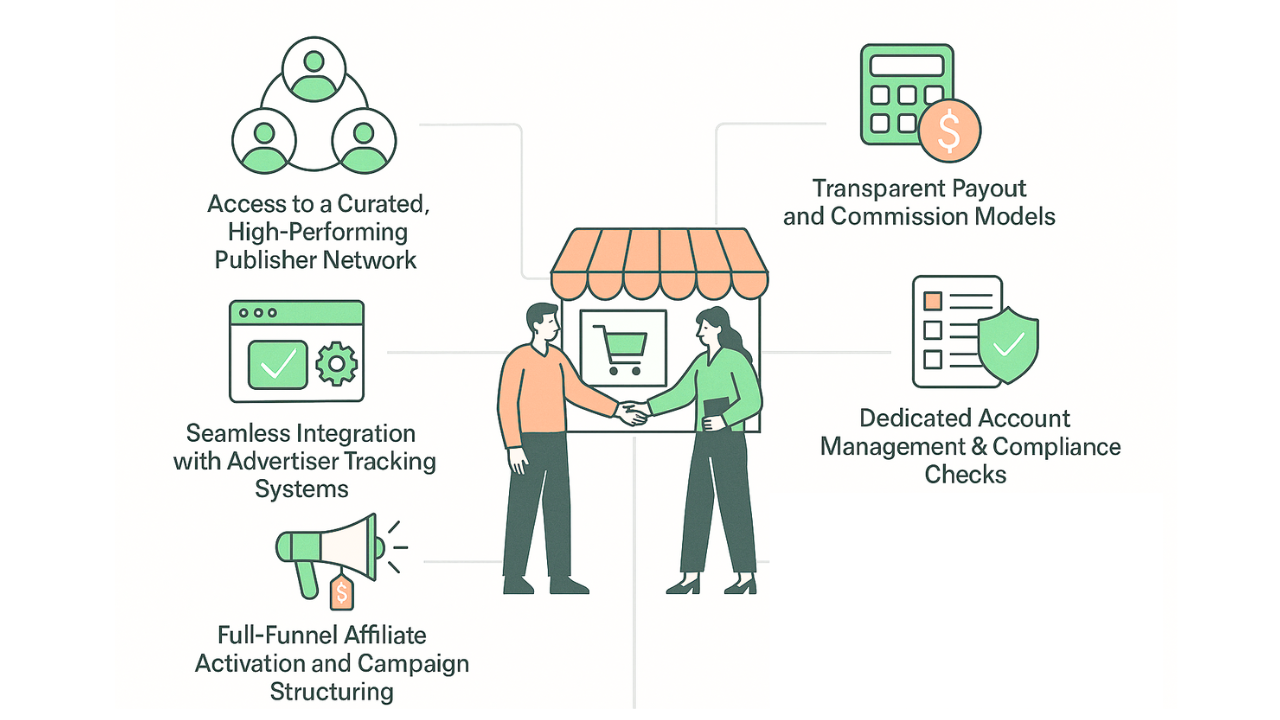
1. Access to a Curated, High-Performing Publisher Network
E-commerce growth relies heavily on visibility across multiple touchpoints. vCommission connects brands to a wide-reaching affiliate network comprising content creators, coupon and cashback platforms, price comparison engines, influencers, and media buyers, each evaluated for relevance, performance history, and compliance.
This curated network allows e-commerce brands to reach consumers at different stages of the buying funnel with the help of affiliates that align with their vertical (e.g., fashion, beauty, electronics, home, or FMCG).
2. Seamless Integration with Advertiser Tracking Systems
vCommission integrates efficiently with the brand’s existing tracking setup. Instead of enforcing proprietary systems, vCommission aligns tracking macros and parameters to reflect conversions directly within the advertiser’s panel. Brands retain complete visibility into real-time conversions and affiliate performance, attribution sources and quality of traffic, and ROI and cost-per-action metrics, matched against internal KPIs.
3. Full-Funnel Affiliate Activation and Campaign Structuring
vCommission supports campaign structuring based on performance objectives, allowing e-commerce brands to activate partners across different funnel stages:
Awareness (top publishers, influencers, and media buying affiliates help drive reach and visibility)
Consideration (review sites and niche content creators aid in product education and trust-building)
Conversion (coupon, cashback, and deal affiliates drive intent-led traffic for last-mile conversions)
This structured funnel-based approach ensures that affiliate activities align with brand-specific sales goals and marketing timelines.
4. Transparent Payout and Commission Models
With clear, predefined payout structures, vCommission ensures that affiliate compensation is directly tied to performance outcomes such as confirmed sales or qualified leads. Brands have full control over commission rules (e.g., product category-based, new vs. returning users), validation cycles for sales, and budget allocation across affiliate types.
E-commerce brands working with vCommission receive strategic guidance from experienced account managers who understand category dynamics and channel-specific affiliate behavior. These account managers manage everything from onboarding to campaign optimisation, including fraud detection, affiliate matching, performance metrics, and compliance checks.
The Bottom Line
By avoiding the most common affiliate marketing mistakes, like partnering with the wrong affiliates, overlooking compliance, using a single pricing model, and lacking real-time tracking, e-commerce brands can achieve high ROI and scalable growth. This entails having the proper marketing plan, performance visibility, and infrastructure operating in the background for e-commerce brands.
At vCommission, every campaign is built on data-backed execution, transparent tracking, and a deep understanding of how to reach audiences at the right moment. From seamless integration with your tracking systems to structured, full-funnel performance strategies, the focus stays on what matters most: extensible growth and ROI.
If you are looking to improve results, vCommission offers a reliable framework designed to deliver a measurable impact efficiently and at scale. Sign up Now!