

 Dot & Key Women’s Day Offer: A High-Conversion Campaign for Beauty Affiliates
 DAZN Campaign Overview: Capitalize on the Growing Sports Streaming Audience
 Kinguin Affiliate Program: A High-Conversion Offer for Gaming Publishers
 Inside the Shopee Campaign: Scale Your Affiliate Earnings in High-Growth Markets
 SmartFinancial Affiliate Program: Perfect Campaign to Monetize Insurance Traffic
As India’s D2C ecosystem evolves, many brands are realising that scaling is very different from getting started. Early growth often comes from one strong channel or a winning product, but as brands grow, those same levers stop delivering consistent results.
This challenge is reflected in a report by DSG Consumer Partners, which shows that nearly 60–65% of Indian D2C brands remain stuck in the ₹1–50 crore revenue band.
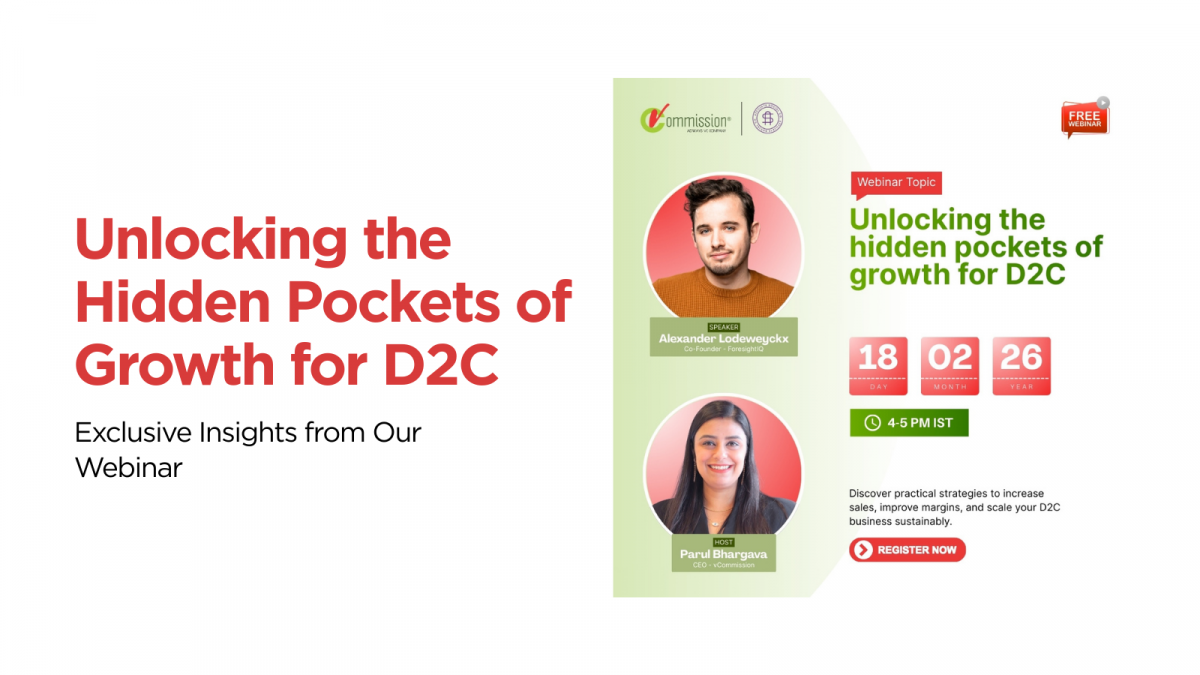
To address this gap, vCommission, in association with Affiliate Social, hosted an exclusive webinar on “Unlocking the Hidden Pockets of Growth for D2C.” The session featured Parul Mehta Bhargava and Alexander Lodeweyckx (Co-Founder of ForesightIQ), sharing practical ways to help brands move beyond plateaus and build scalable growth systems.
Alexander started the conversation with a fact that many founders already know. Early growth feels straightforward- one product, one ad channel, a few campaigns, and the numbers rise. But as brands grow, those same channels stop delivering consistent results. Ads get more expensive, conversions slow down, and growth becomes unpredictable.
He broke the solution into three levels of growth:
After explaining the three levels of growth, Alexander highlighted the next step to figure out where to put your time and resources.
Many brands try to scale by doing everything at once: more campaigns, more creatives, more channels. This often creates noise instead of results. The key is to focus on the levers that actually drive growth, whether it’s a channel, an audience, a landing page, or a specific offer. Small, targeted changes in the right areas can create big results.
For example, in a $10M D2C brand:
For a $100M D2C brand:
It shows that growth is about identifying the highest-impact levers and focusing your resources there.
Alexander also shared a practical framework called the Marketing Inventory Model, designed to help brands decide where to focus their time and resources. The model breaks growth down into key areas:
By mapping all these levers in one place, brands can clearly see what’s driving growth, what needs attention, and where to invest next.
Alexander also emphasized resource allocation within this framework. Instead of spreading teams and budgets thin, brands should focus on the levers that deliver the highest incremental impact, and correlate effort with measurable results.
For example, in one case study, increasing ad spend on a high-performing product led to over 100% correlation with revenue growth, while scaling less effective campaigns had little impact. This demonstrated the importance of aligning resources with performance rather than intuition.
The webinar also explored how brands can leverage AI and user-generated content (UGC) to improve campaign performance. Alexander shared a case study of a holiday promotion for Loop Dream Earplugs.
The campaign combined:
By aligning the offer, funnel, and messaging with a clear use case, the campaign successfully turned a functional product into a high-value gift option, maximizing both conversions and revenue.
Alexander stressed the idea of leveraging AI to analyze and understand the campaign’s performance more quickly, understand which creatives and approaches are resonating well, and make recommendations on optimizations. This can be done alongside a well-structured UGC.
Track which channel brought the customer first (using UTMs or analytics) and give credit for the sale. Compare revenue from each channel to see which drives extra sales.
Focus on five things: traffic that converts, strong offers people want, funnels that guide people to buy, testing everything consistently, and tracking what actually leads to sales.
If clicks drop but reach stays the same, your ad is getting boring: refresh the creative. If the reach stops growing, your audience has seen it all: try new audiences.
Often, yes. Influencers only drive results when tied to a clear offer, trackable link, or measurable goal. Reach or followers alone rarely lead to actual sales.
Start with a small launch and track sales, engagement, and repeat purchases. The products that perform well consistently are your hero products, and then you can invest more to scale them.
No. Customize landing pages for each campaign, audience, or offer to stay relevant and maximize conversions.