

 OND 2026: How to Find the Right Campaign for Every Stage of the Shopping Season
 Diwali Sale Picks: Top Home Appliance Affiliate Programs to Promote in 2026
 Tommy Hilfiger 11.11 Sale: Top Deals for Global Fashion Shoppers
 Hawkers Affiliate Campaign: Top Converting BFCM Opportunity for Latin American Publishers
 The 11.11 Affiliate Opportunity Guide: Global CPS Campaigns Across Markets and Verticals
26% of orders were returned in India last year, according to ShipNotes. For businesses using cash on delivery, that number points to a much bigger challenge than payment preference. A COD order can be generated and confirmed, yet still end up as a failed delivery if the customer refuses the parcel at the doorstep.
So, what can India learn from markets where COD has already become a mature e-commerce model?
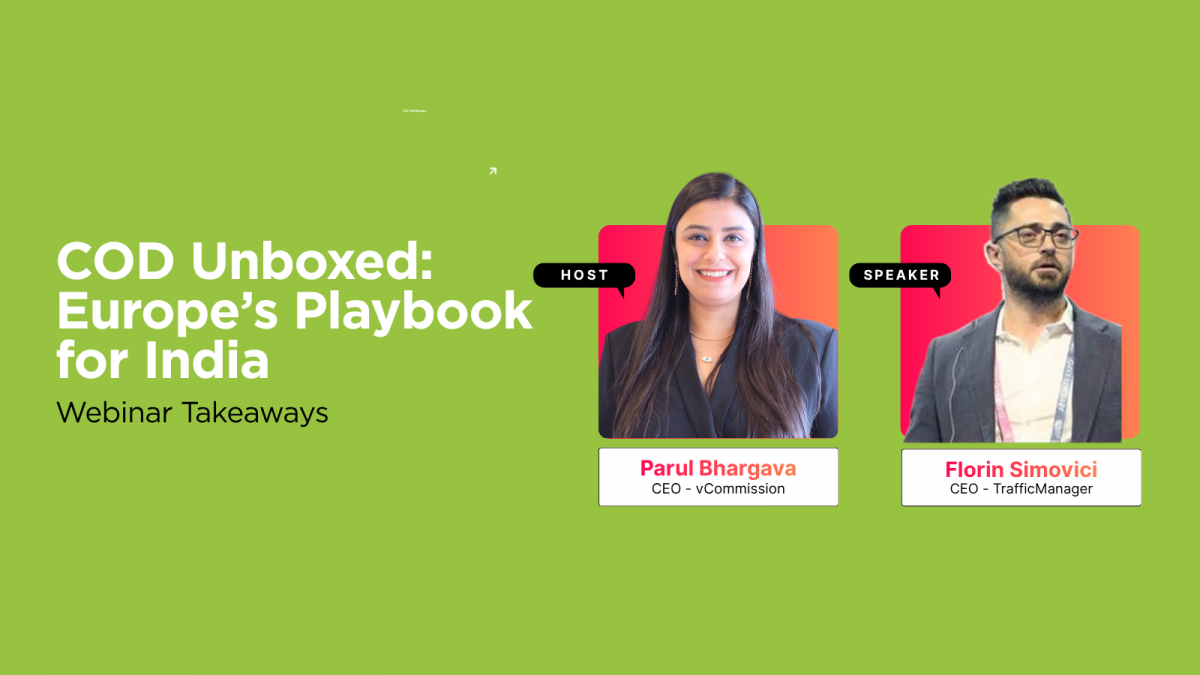
To explore this, vCommission hosted yet another exclusive webinar in association with affiliate social, “COD Unboxed: Europe’s Playbook for India,” featuring Florin Simovici, Co-Founder and CEO of TrafficManager, and Parul Mehta Bhargava, Co-Founder and CEO of vCommission. The discussion looked at how COD evolved in Europe, what makes the model work, and where India could take it next.

Florin began with a simple point. COD may look like a payment method, but modern COD is actually an entire supply chain.
The process starts with a store or landing page, often built on Shopify, WooCommerce, or a dedicated product page. From there, the order moves into local fulfillment, where stock is already available in the target country.
Then comes order confirmation. A call center, either through human agents or AI-based systems, confirms the order and checks details such as the customer’s address. It can also identify suspicious or low-quality orders before they reach fulfillment.
The final step is payment at the door, where the customer pays the courier after receiving the parcel. Some COD models also allow customers to inspect the package before paying.
Behind all of this is the traffic source. Affiliates and media buyers bring customers to the offer and generate the orders that feed the entire system.
As Florin explained, COD was introduced in Switzerland as far back as 1849. What has changed is everything built around the payment itself.
Florin then took the discussion back to India.
Modern COD became a major part of Indian e-commerce around 2010, when Flipkart allowed customers to pay the courier after confirming orders over the phone. The company also built Ekart to strengthen its delivery network and manage the operational side of COD.
At the time, online payments were still unfamiliar to many consumers. Some shoppers did not have cards or bank accounts, while others simply did not trust entering payment details online.
COD removed that barrier.
Customers could place an order without paying upfront and hand over the money only when the product arrived. This helped e-commerce reach a much wider audience, particularly in Tier 2 and Tier 3 cities.
Amazon eventually adopted the model too.
The bigger lesson from this history is that India did not simply adopt COD as a payment option. It built an entire e-commerce ecosystem around it.
The role of COD has changed since 2010.
Florin explained that COD initially solved an access problem. Customers needed a way to shop online when cards and digital payments were not widely available.
Today, the problem is often trust.
A customer may have a credit card, UPI, or another digital payment option but still hesitate to pay a new brand upfront after discovering it through a Facebook or Instagram ad.
COD gives that customer another choice.
They can place the order, receive the product, and pay at the door.
For affiliates, this is an important distinction. COD can help reduce the hesitation around purchasing from an unfamiliar brand, particularly when the product is discovered through performance advertising.
Florin then traced the journey of COD into Europe.
After expanding through parts of Asia and the Middle East, COD gained strong adoption in countries such as Italy and Spain.
There was a clear reason for this. Both markets had strong teleshopping industries at the time.
Television created huge demand for products that people saw in advertisements and demonstrations. But buying television advertising was expensive, and businesses needed fulfillment centers and call centers to manage the resulting orders.
Then digital advertising changed the equation.
Facebook and Google gave media buyers a cheaper and more measurable way to generate traffic. Instead of paying for expensive TV slots, businesses could buy traffic and measure the sales that followed.
COD had found a new growth engine.
One of the most important distinctions Florin highlighted was between COD and traditional dropshipping.
A typical COD operation holds stock in a local warehouse. Customers can receive their products within a few days and pay the courier at delivery.
Classic dropshipping usually works differently. The product remains with a supplier, often in China, and is shipped directly to the customer after an upfront payment.
That creates a major difference in the customer experience.
COD usually depends on local stock, faster delivery, and payment at the doorstep. Dropshipping often depends on low product prices and longer delivery times.
The two models may use similar advertising channels and landing pages, but their underlying businesses are very different.
Florin then explained how dropshipping challenged the COD ecosystem around 2015.
The combination of AliExpress, Oberlo and Shopify made it possible for almost anyone to launch an online store and ship low-cost products directly from China.
This model spread quickly across markets including France, Italy, Spain, Germany and the UK. It also gained ground in Central and Eastern European markets where local COD infrastructure was not yet as developed.
Customers were often willing to pay a low price and wait several weeks for delivery.
But the model faced a major change in July 2021, when the EU removed the €22 VAT exemption for low-value imports and introduced the IOSS system.
A study published in the Journal of Public Economics found that the reform was associated with a substantial decline in cross-border online sales from China to EU countries.
The change made the economics of very low-value cross-border parcels less attractive.
Businesses began looking for another approach. Many moved inventory into local European warehouses, bringing stock closer to customers.
COD once again became a stronger option for European e-commerce.

Between 2021 and 2024, COD expanded further across Central and Eastern Europe.
The markets highlighted during the webinar included Greece, Bulgaria, Slovakia, Serbia, Lithuania, Poland, and Italy.
According to the ECDB figures presented in the webinar, COD was offered by 85.6% of online shops in Greece, 80.3% in Bulgaria, and 80.1% in Slovakia. Poland was also above 60%.
COD is not equally popular everywhere. Western Europe and Scandinavia generally have much lower adoption, while Central, Southern, and Eastern European markets continue to show stronger demand.
For affiliates these differences affect campaign performance. A strategy that works in Italy or Bulgaria may not perform the same way in Germany or the UK.
Florin then moved from payment behavior to product categories.
COD tends to work best for products that can generate an impulse purchase and sit within a price range customers are comfortable paying at the door.
The webinar highlighted a typical range of around €30 to €60, although upselling can increase the final basket value.
The strongest categories include:
Nutra and cosmetics were highlighted as two particularly strong categories across European COD markets.
For affiliates, product choice should also influence the content format. A product that can be demonstrated quickly may work better through a Reel, short-form video, or creator-led demonstration than through a text-heavy promotion.
The next part of the webinar connected COD directly with affiliate marketing.
COD had already existed in Europe for years. What changed was the ability to track traffic and attribute sales to individual partners.
Once advertisers could measure which affiliates were generating orders, they could pay based on performance rather than simply buying advertising space.
Affiliate networks became an important part of this ecosystem.
Florin outlined three common structures.
The infrastructure behind these models often includes third-party tracking platforms, fulfillment centers, and call centers.
Florin eventually brought the discussion back to India.
The country already has many of the ingredients needed for COD at scale. It has a large online shopper base, established fulfillment networks, and extensive call-center capacity.
The opportunity now lies in improving the performance layer around COD.
Affiliate networks and advertisers need to understand not only how many orders an affiliate generates, but also what happens to those orders afterward.
Fingerprint-level tracking can help identify traffic patterns linked to poor-quality orders and connect information across the customer journey.
During the webinar, Florin also clarified that this does not automatically mean networks can see every advertisement an affiliate is running. Accessing the actual ads would require additional API integration.
The goal is to understand traffic quality and order outcomes more accurately.
For affiliates, the European COD story offers a practical lesson.
COD campaigns should not be judged only by the commission or the number of orders generated. The quality of those orders matters just as much.
Promotional content should accurately represent the product and offer. Affiliates should avoid exaggerated claims that may generate clicks but increase refusals later.
It is also important to understand the market before promoting a European COD campaign. Payment behavior varies widely across countries, and product demand can differ from one market to another.
India’s COD ecosystem is already moving towards this more performance-focused approach. Through its India COD ecosystem, vCommission gives affiliates access to COD offers with visibility across the order journey, from the initial order to shipping and delivery. Sub ID tracking helps identify the traffic source, while post-order events provide a clearer picture of whether an order actually reaches the customer. For affiliates, that means performance is not simply about generating an order. The quality of that order can be tracked further down the funnel.
That shift is important for COD because the real conversion does not necessarily happen when the customer submits the order. It happens when the product reaches the customer and the order is successfully delivered.
Fingerprint-level tracking helps identify traffic patterns and link them to order outcomes.
No. That requires additional API integration.
No. COD is more popular in markets such as Italy, Greece, Bulgaria, and Poland than in the UK, France, and Germany.
They can join COD programs and attend industry events to learn about the market and build connections.
By tracking orders beyond confirmation and identifying affiliates that generate successfully delivered orders.