

 BFCM Tech Deals: Scale Your Revenue with High Paying Saas Campaigns
 From US to India: Taking Your Nutra & Ecom Campaigns Into a New Market – Webinar Highlights
 11.11 Travel Deals: How to Promote Flight & Hotel Discounts to Singles Day Shoppers
 Lifelong Affiliate Program: Promote Smart Home & Kitchen Deals This Diwali
 BFCM Affiliate Marketing Strategy: How to Choose the Right Global Campaigns
Affiliate marketing operates on trust. However, that trust often breaks down more than the industry would like to admit, affecting consumers, affiliates, and advertisers alike.
Take the consumer side. 90% of consumers say trust is a deciding factor before making a purchase, according to the Edelman Trust Barometer. However, there is another layer of trust that gets far less attention. The trust that needs to exist between affiliates and advertisers. That is where a lot of value quietly slips out of the channel.
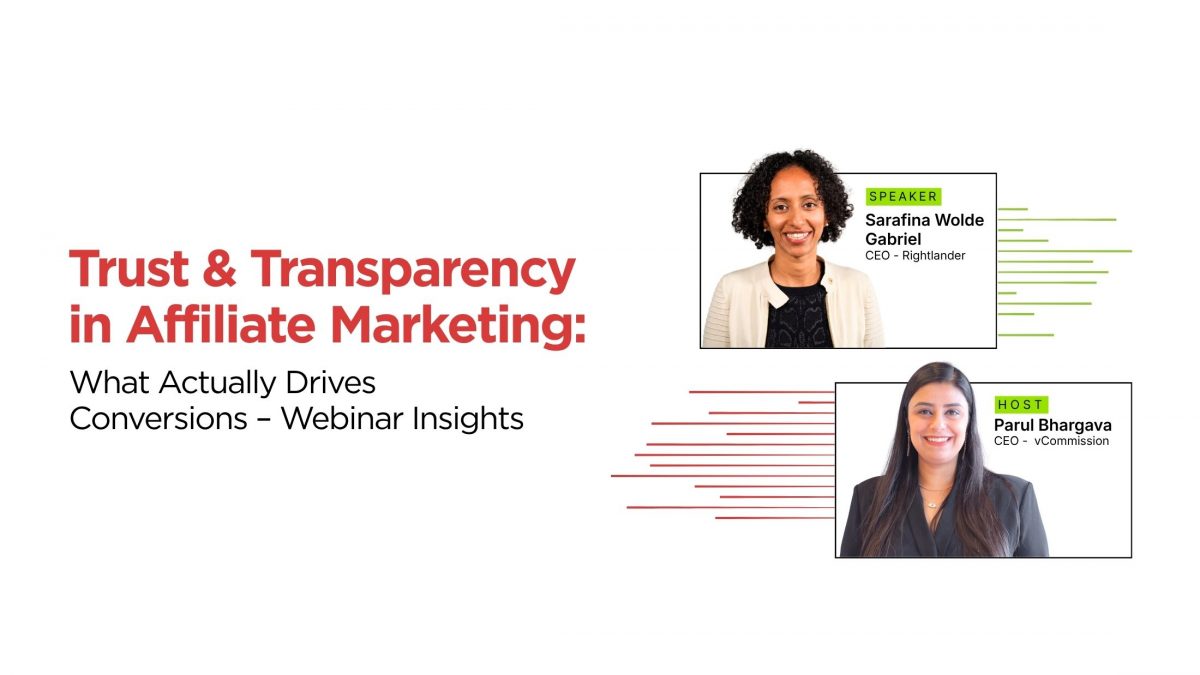
This is what vCommission set out to talk about in a recent webinar hosted in partnership with Affiliate Social. The session featured Parul Mehta Bhargava, Co-Founder and CEO at vCommission, and Sarafina Wolde Gabriel, CEO of Rightlander. Here is how the conversation went.
Sarafina opened the discussion by explaining the real impact of non-compliance in affiliate marketing. Marketing violations can lead to fines, regulatory investigations, consumer compensation, lost revenue, and months of operational disruption. These are not rare worst-case scenarios. They happen, and the costs add up fast.
Most affiliates hear this and think it is the advertiser’s problem to deal with. Sarafina made clear that it is not that simple.
When advertisers get hit by non-compliant affiliate activity, the whole channel tightens up. Approvals get harder. Traffic sources get restricted. And if the issue is traced back to a specific affiliate, the impact is very direct. Commissions get frozen, accounts get closed, and the reputation that follows makes it harder to get into the next programme.
Transparency is not just about following rules. It is about protecting your business.

From there, Sarafina moved into a question that comes up all the time in affiliate marketing but rarely gets a straight answer. When advertisers ask for quality traffic, what do they actually want?
It is not just about conversion rates. What advertisers want is visibility. They want to know where the users came from, what they were shown before they clicked, and what brought them to the page. Without that context, even strong numbers can raise more questions than they answer.
An advertiser who cannot see where their traffic is coming from cannot fully trust what they are paying for. And when trust runs low, approvals slow down, criteria tighten, and good affiliates get caught in filters that were not meant for them.
Traffic gets users to the page. Transparency is what keeps the relationship going.

This led to one of the most useful parts of the session. Parul raised something she said comes up a lot in her conversations with advertisers. The specific challenge of building trust around media buying traffic.
With coupon sites or content placements, an advertiser can look at the page and see exactly what is being said about their brand. They can check if the offer is current, if the landing page is right, and if the tone fits. It is visible. Media buying is not.
When an affiliate runs paid media, the advertiser has no direct way to see where those ads are showing up. They are relying entirely on what the affiliate tells them. And as Sarafina explained, that is where things can go wrong without anyone noticing until it is too late.
She shared a real example. In the gaming industry, an ad for an age-restricted product ended up on a college website, in front of an audience it should never have reached. When the brand looked into it, a national newspaper had placed the ad through a media buying campaign. The brand had no idea. The newspaper had not flagged it. It slipped through because nobody was watching closely enough.
The uncomfortable truth, Sarafina said, is that with media buying, you usually find out something went wrong only after it has already happened. That is exactly why affiliates in this space need to communicate more upfront. Because the programme has no other way to know what risk it is taking on.

Sarafina then walked through some questions that sit at the root of most transparency issues in the channel.
Do affiliates and advertisers even agree on what good traffic means? Often they do not. An affiliate focused on volume and clicks may feel they are doing well. An advertiser in a regulated industry looking at the same numbers without any context may see a compliance risk. Neither is necessarily wrong. They are just working from different expectations that no one has taken the time to align.
Are affiliates getting clear enough guidance from the programmes they work with? In a lot of cases, no. Compliance rules are buried in long-term and conditions, differ across verticals, and change without much warning. Expecting affiliates to independently stay on top of rules that are never clearly explained is a gap the industry has not done enough to fix.
And here is a reframe worth sitting with. Can a rejection sometimes be a transparency problem rather than a performance problem? Yes. When a programme cannot clearly see where traffic is coming from or how a product has been promoted, the safest thing to do is decline. The affiliate may have done nothing wrong. The problem is that the programme did not have enough information to be sure.
Towards the end of the session, Sarafina shared some practical advice for affiliates looking to build long-term partnerships, such as:
Be honest about how you drive traffic. Do not wait for someone to ask. Tell advertisers upfront what you are doing and where your traffic comes from. It builds confidence and makes everything easier down the line.
Know what you can and cannot do on each platform. Rules differ across Google, Meta, TikTok, and paid media networks. They also change regularly. Keeping up with them is not optional; it is part of the job.
Know the rules of the industry you work in. Finance, health, insurance, and gaming each have their own compliance requirements. What is acceptable in one sector may get you flagged in another.
Do not wait until your commissions are frozen or your account is banned. By then, it is too late. Stay proactive, keep communication open, and do not let small transparency gaps turn into bigger problems.
Just check with the Affiliate Manager before running your own offer. A quick approval keeps things clear and avoids issues later.
Both sides should be open from the start. Affiliates share how they drive traffic, and advertisers share their rules and expectations.
It comes down to transparency. If the traffic source doesn’t match what was shared, it immediately needs clarification.
Try other ways to reach them, like WhatsApp, social media, or even industry contacts. Good communication makes things smoother.
AI is increasing content volume, so brands are focusing more on authenticity and spotting low-quality or misleading content.
Yes. Affiliates who are transparent and follow rules are more trusted and often get better long-term partnerships.