

 BFCM Tech Deals: Scale Your Revenue with High Paying Saas Campaigns
 11.11 Travel Deals: How to Promote Flight & Hotel Discounts to Singles Day Shoppers
 Lifelong Affiliate Program: Promote Smart Home & Kitchen Deals This Diwali
 BFCM Affiliate Marketing Strategy: How to Choose the Right Global Campaigns
 The OND Conversion Roadmap: Convert Festive Traffic into Affiliate Revenue
A campaign that works in the US has already gone through testing. You have data, creative learnings, consumer insights, and an offer that has proven its potential.
But what happens when you take that campaign to India?
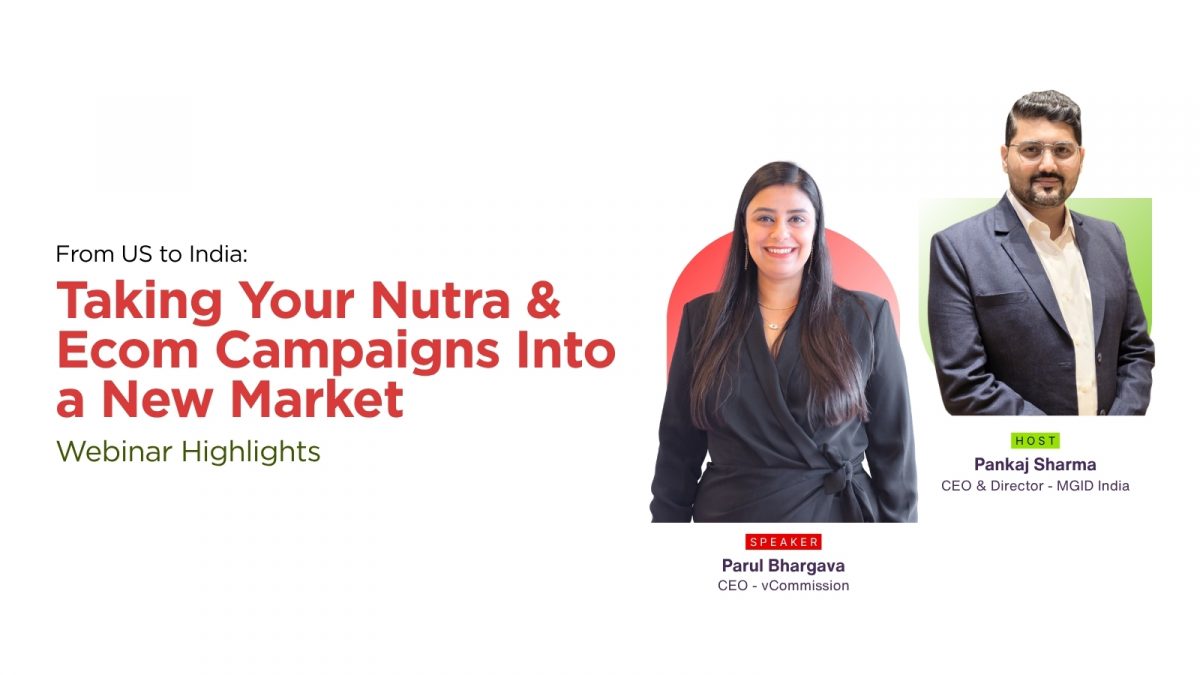
To unlock this, vCommission and MGID joined hands for a live session on “From US to India: Taking Your Nutra & Ecom Campaigns Into a New Market. The webinar featured Parul Mehta Bhargava, Co-founder & CEO of vCommission, and Pankaj Sharma, CEO & Director of MGID India. They discussed what makes India different, where US campaigns can still give advertisers a head start, and what needs to change before increasing traffic.
The opportunity is hard to ignore. According to Infisum, India’s e-commerce market is expected to grow from $125 billion in 2024 to $345 billion by 2030.
For advertisers and affiliates, the opportunity is not simply about entering a larger market. It is about understanding how that market works.
Pankaj started the discussion by looking at the Indian market and its scale. Parul then took the conversation a step further.
She emphasized that advertisers and affiliates need to look at India as a market with its own consumer behavior rather than simply another geography to add to an existing campaign.
India has a population of more than 1.3 billion and a large English-speaking consumer base. Its online shopping ecosystem is also expanding rapidly.
The webinar highlighted several factors behind this opportunity. India has a massive consumer base; more advertisers are focused on measurable customer acquisition, and D2C brands continue to build their online presence.
There is also no single Indian consumer profile.
Different regions have different purchasing power. Consumers respond differently to prices and offers. Purchase motivations can change across categories and audiences.
That diversity gives advertisers more room to test.
She described this as India’s blue ocean opportunity. The opportunity is bigger than scale because the market allows advertisers to explore multiple categories, audiences, and price points.
That is important when thinking about affiliate marketing in India. Ecommerce affiliate programs don’t necessarily need to depend on one audience or one traffic strategy.
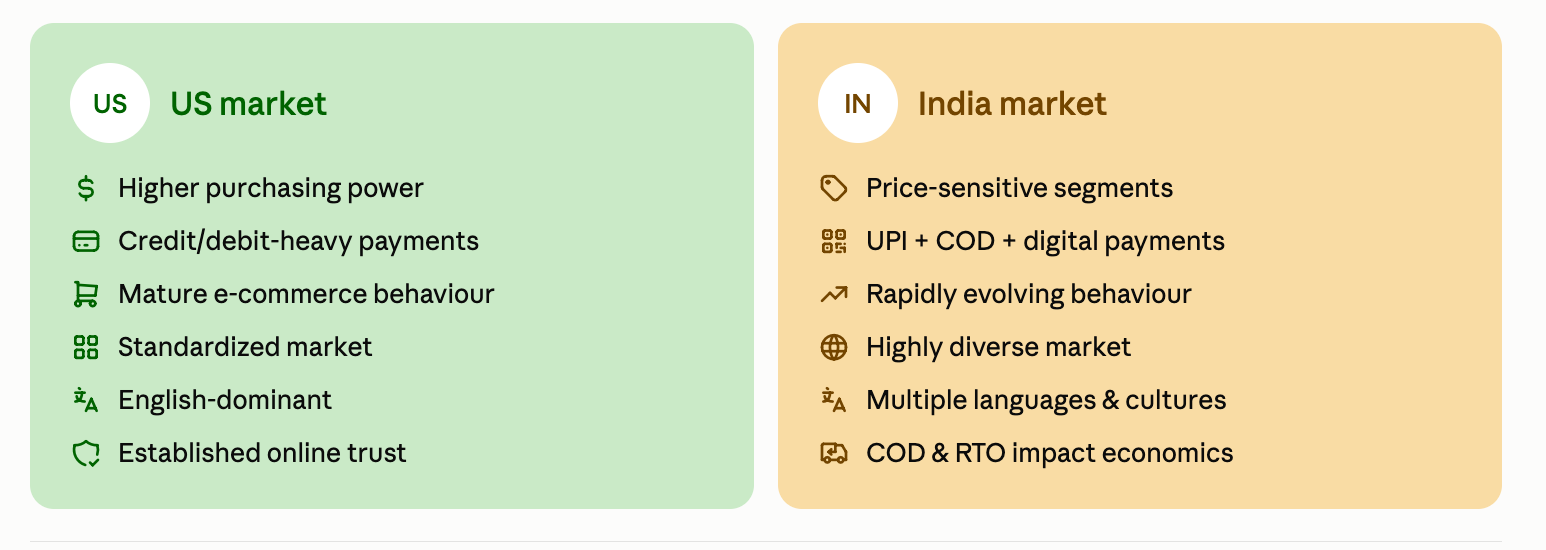
Parul then compared the US and Indian markets.
A successful US campaign already gives advertisers useful data to work with. They know which creatives attracted attention. They have some understanding of the customer and the offer.
But India changes several parts of the equation.
The differences is in consumer behavior, price sensitivity, payment behavior, trust, and the operational side of fulfilling an order.
In the US, consumers generally have higher purchasing power, and credit or debit cards play a major role in online payments. The Indian ecommerce market is also more mature and standardized across many categories.
India is different.
Consumers can be much more price-sensitive. UPI and other digital payment methods are important, while COD can still influence how campaigns perform. The Indian ecommerce market is also more diverse in terms of language, geography, and consumer behavior.
Then there is the operational side of affiliate marketing in India.
An order does not necessarily mean revenue. Confirmation, dispatch, delivery, and RTO can all affect the final economics. So the question is not whether a US campaign can work in India. It is whether the ecommerce affiliate programs can be adapted to Indian affiliate marketing.
This was an important distinction in the webinar. A US campaign should not be thrown away when entering India. The existing campaign already contains valuable information. It can tell you which creative angles attracted attention. It can show what consumers responded to. It can provide insight into the offer and help identify where the funnel worked or failed. What changes is how those learnings are applied.
Parul described the process as:
Research → Validate → Localize → Track → Optimize → Scale
Research comes first. Understand the Indian audience and the category before spending heavily. Then validate the product, offer, price, and economics. Localization comes after that. The creative and landing experience may need to change even when the product remains exactly the same. Tracking then needs to cover the full customer journey. Only after the campaign starts producing reliable results should traffic and budgets increase.
The conversation then moved into what actually changes for different campaign categories.
For Nutra, Parul highlighted trust, education, proof, compliance, and the value proposition.
E-commerce campaigns bring a different set of considerations, including price, offer, COD, delivery, RTO, and customer experience.
The two categories may require different approaches, but both depend on the same foundation:
Right audience + right creative + right funnel + right economics
That difference becomes obvious when you look at the type of product being promoted.
Parul gave shapewear as an example where direct product selling can work. If the creative is strong and the product is easy to understand, the consumer may not need a long educational journey.
A product such as a smart band or hydrogen bottle can require more explanation. In that case, sending cold traffic directly to a product page may not be enough.
A pre-lander can explain the product and its benefits before the visitor reaches the purchase page.
This is an important consideration when building ecommerce affiliate programs. There is no single funnel that works for every product.
Pankaj then took over and moved the discussion towards creatives. One of his main points was speed. Creating dozens of creative variations manually can take considerable time. AI can help marketers produce first drafts much faster. That includes headlines, customer personas, FAQs, sales copy, and different creative angles.
For example, a baseline headline such as “The Natural Formula for Healthy Joints”
can be developed into different directions around daily routines, staying active, or expert recommendations.
The value is not simply having more headlines. It is being able to test different ideas quickly.
But Pankaj also made an important qualification, especially for Nutra affiliate marketing in India.
AI does not replace human judgment when compliance is involved. Health campaigns have strict requirements around claims. AI can miss regulatory nuance or produce language that needs to be reviewed before it goes live.
So the useful combination is AI plus marketing expertise. AI can help generate the ideas faster. Human expertise decides which ideas are appropriate.
The discussion then moved from individual creatives to the broader funnel. Pankaj argued that a clickbait headline followed by a promotional article is no longer enough for native traffic.
The content needs to provide something useful before asking the consumer to buy. That could mean an educational article, a relatable story, an expert explanation, or an interactive experience. He also discussed quizzes, assessments, calculators, and polls as ways to make the experience more engaging.
Micro-segmentation can make the content more relevant too. A campaign aimed at new parents does not need to speak in the same way as one aimed at travelers, fitness audiences or people over 60. Native video can also support the funnel through product demonstrations, explainers, expert interviews and testimonials.
The idea behind these Nutra campaigns was straightforward. Give people a reason to keep reading before giving them a reason to buy.
Pankaj then walked through what a realistic Nutra funnel could look like.
It begins with a native ad based around a consumer concern.
The visitor moves to an educational advertorial that discusses the concern and possible approaches without making exaggerated claims.
A short quiz can then help the visitor identify a routine that fits their goals.
The product page comes later.
At that stage, the consumer should be able to find the information needed to make a decision, including ingredients, studies, FAQs, reviews, pricing, and a clear CTA.
Trust also needs to extend beyond testimonials.
Pankaj discussed case studies, permitted user-generated content, expert commentary, and objective product comparisons as forms of social proof.
He also suggested building a content hub rather than relying entirely on a product page. Articles, videos, FAQs,s and guides can give visitors more space to understand the product.
This approach can be particularly useful in Nutra affiliate marketing in India, where the consumer may need more information before making a purchase.
Parul then brought the discussion back to the Indian affiliate marketing.
This was one of the biggest differences highlighted during the webinar.
An order is not the end of the funnel.
For an Indian campaign, the journey can continue through:
Traffic → Landing Page → Order → Confirmation → Dispatch → Delivery → Payment → Revenue
That means advertisers and affiliates cannot judge a campaign only by clicks, orders, or CPA.
Other numbers matter too.
CTR and CVR tell you what happened earlier in the funnel. CPA tells you what the acquisition cost looks like.
But confirmation rate, RTO, delivery rate, AOV, and revenue help show whether the campaign is actually working commercially.
This is particularly important for performance marketing in India because a campaign can look profitable at the order stage and become much less attractive after cancellations or returns.
Parul explained that vCommission has a tracker that helps affiliates understand these economics. Affiliates can use campaign data around CPA, product price, and RTO to work out whether an offer remains profitable at different return levels.
That gives affiliates a better basis for choosing campaigns.
Instead of asking only, “What is the payout?”
They can also ask, “What does this campaign look like after delivery?”
Once a brand has tested its campaign and understands what is working, the next challenge is scaling without losing control of performance. Parul explained that this requires more than simply increasing the budget. Brands need reliable tracking, the right partners, and visibility into the quality of the traffic they are receiving.
vCommission connects advertisers with affiliates and performance partners while providing tracking and reporting across campaigns. Real time data and SubID tracking can help brands understand which partners and traffic sources are driving results. This gives advertisers a clearer view of campaign performance when deciding where to increase their spend.
The webinar also introduced DTCX, vCommission’s newly launched platform for D2C brands. The platform connects brands with creators and media buyers to support customer acquisition and help them explore new growth channels. This gives D2C brands another way to find relevant partners once they have validated their offer and are ready to expand.
Parul shared Qorfit as an example during the session. The smart health and fitness brand scaled its orders 19X in one quarter through vCommission’s D2C Growth Engine. The example showed how brands can move from testing to scaling by identifying the partners and acquisition channels that are delivering quality results.
vCommission has a tracker where affiliates can check their CPA, product price, and RTO levels to see if a campaign is still profitable. This helps them understand the real economics before choosing a product.
It depends on the product. Parul gave shapewear as an example where direct selling can work if the creatives are good. For products like smart bands or hydrogen bottles, a prelander can help explain the product and its benefits before the customer reaches the product page.
Start with at least ₹5,000 for 7 to 10 days. The goal is to check metrics such as the cost of an order placed, shipped, and delivered, and see if the product makes sense in the Indian ecommerce market.
The budget also depends on the product price. For a higher ticket product like an ₹8,000 hydrogen bottle, the testing budget and campaign metrics need to be looked at differently.