

 How Affiliates Can Generate Consistent Revenue with PPC Affiliate Marketing in 2026
 Credit Card and Loan Affiliate Campaigns: Strategies for Higher Conversions
 Semrush Affiliate Program: A High-Payout Offer for Marketers and SEO Publishers
 10 Best Affiliate Marketing Platforms of 2026
 Fintech Affiliate Campaigns: Monetizing Finance Traffic with High-Payout Offers
Do you remember the days when writing content, checking reports, and testing creatives used to take forever? Today, AI does all that in seconds. With 79.3% of affiliate marketers already leveraging AI (Hostinger), it’s clear this shift has quietly become the new normal.
Yet, with all this speed, a question remains: Is our ethical framework keeping pace with AI’s acceleration?
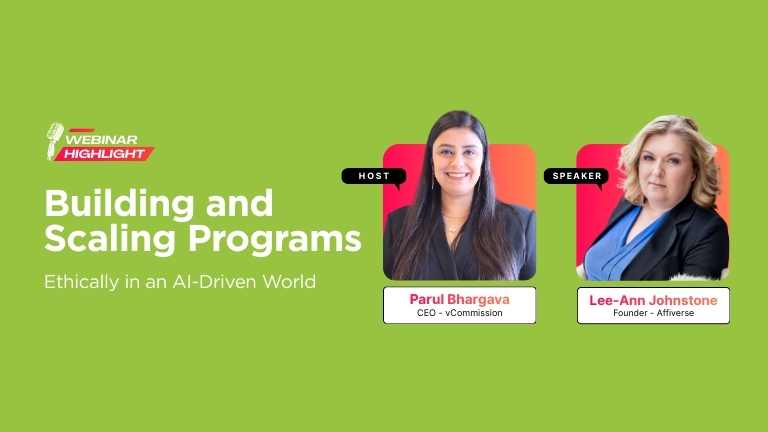
This was the focus of our recent webinar hosted by Parul Mehta Bhargava, CEO & Co-Founder, vCommission, featuring Lee-Ann Johnstone, CEO & Founder, Affiverse. In the session, we explored AI’s transformative impact on affiliate marketing and why ethics must stay at the forefront.
Parul and Lee-Ann began the session by discussing how AI has changed the way affiliate marketers work. Decisions are faster, campaigns scale quickly, and understanding customer behaviour is now far more accurate. Tasks that once took hours can now be completed in minutes, and the possibilities continue to grow every day.
Lee-Ann further discusses how deeply AI is already shaping performance marketing. She pointed out that automation is becoming a core part of campaign planning and execution, helping teams:
AI is improving efficiency across the board, but it also brings a responsibility to stay transparent and ethical. That balance is where the industry conversation needs attention now.
As AI becomes more integrated into everyday workflows, the role of ethics is becoming clearer and more important. Moreover, our speaker highlighted how the industry relies on trust between affiliates, advertisers, and customers, and how that trust can easily weaken if technology is used without responsibility.
With AI assisting in content creation, data analysis, and campaign decision-making, mistakes and misuse can spread faster, like exaggerated claims, unclear disclosures, or targeting that crosses the line.
Lee-Ann shared that performance marketing has always grown on credibility. If audiences feel misled, tools and automation won’t fix the damage. Affiliates need clarity on data sources, advertisers must set transparent guidelines, and agencies have to ensure real compliance and review processes. Ethics keeps the industry strong while everything around it evolves.
After demonstrating why ethics matter, she explained that AI should be seen as a support tool, not a replacement for human thinking. She explained that the smartest approach is using AI to enhance judgment, creativity, and decision-making rather than handing full control over to automation.
Some of the practical points discussed included:
The idea was simple: AI can help us work faster and smarter, but the real value still comes from human direction and experience. Humans lead. AI assists.
Launching an affiliate network is complex: tracking, payments, compliance, sourcing quality traffic, and managing relationships. And if you don’t want the full burden, you might be better off running an agency (which handles servicing advertisers/affiliates) rather than owning a network with its full operational overhead.
It’s definitely changing, not disappearing. Advertiser teams often don’t know what they don’t know. AI helps automate many tasks, but you still need strategy, relationships, and traffic sourcing. This is, in fact, a great time to launch an agency if you’re a practitioner, provided you bring expertise, not just automation.
Earlier, a lot of things were done manually. Now AI helps analyse data faster and gives signals about what to do next. It saves time, and that time can be used to focus more on long-term partnerships.
Look beyond your current channels. Test new traffic sources, try fresh angles, and update creatives. When the audience sees the same message repeatedly, performance slows down.
Value has shifted from information delivery to information curation. Anyone can generate content now. What matters is interpretation, unique insight, and trust. Affiliates who bring real perspective will stand out. Bring something people can’t find anywhere else, and always focus on the customer’s needs.